good-luck

Explanation
The Joke
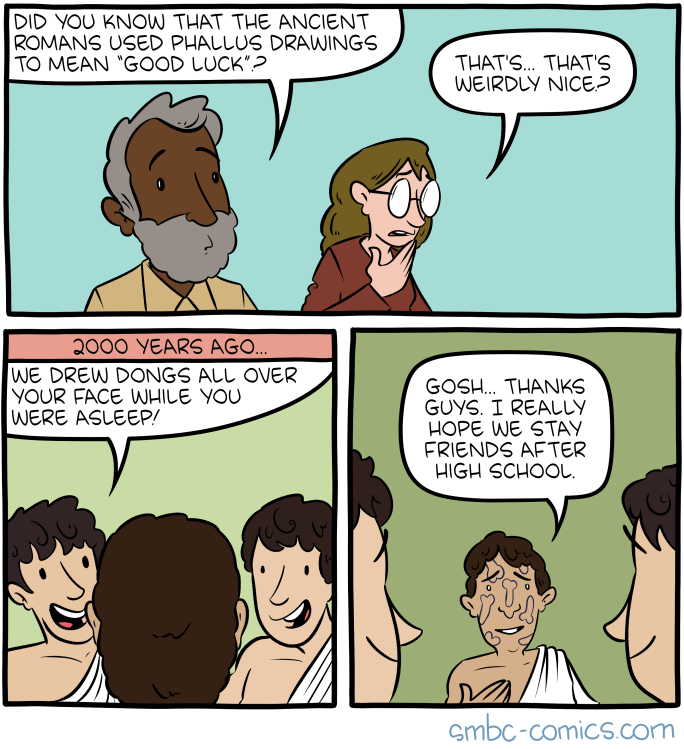
A person shares an interesting historical tidbit: "Did you know that the ancient Romans used phallic drawings to mean 'good luck'?" The other person responds, "That's... that's weirdly nice." This exchange reframes what modern people typically view as crude graffiti into a wholesome cultural practice. The first person then cheerily announces, "So good news! We drew dongs all over your house! You're so lucky!"
The final panel shows the aftermath: "Gosh, thanks guys. I really wish I'd stayed in touch after high school" -- implying this was done by old high school friends using the historical factoid as a flimsy excuse to vandalize someone's property with phallic drawings, something that is clearly more in line with juvenile pranking than ancient Roman well-wishing.
The Humor
The comedy comes from the deliberate misapplication of a genuine historical fact. Ancient Romans did indeed use phallic symbols (fascina) as good luck charms and protective talismans, placing them on buildings, wearing them as pendants, and carving them into roads. The comic takes this real piece of history and uses it as a justification for something that is unmistakably modern juvenile vandalism. The victim's deadpan response -- wishing they had stayed in touch after high school -- perfectly conveys that the "ancient Roman good luck" excuse fools absolutely nobody.
References
The ancient Roman use of phallic imagery as apotropaic (evil-averting) symbols is well-documented in archaeology. The "fascinum" was a divine embodiment of the phallus believed to ward off the evil eye. Phallic carvings have been found throughout the Roman Empire, from Pompeii to Hadrian's Wall.