happiness-3

Explanation
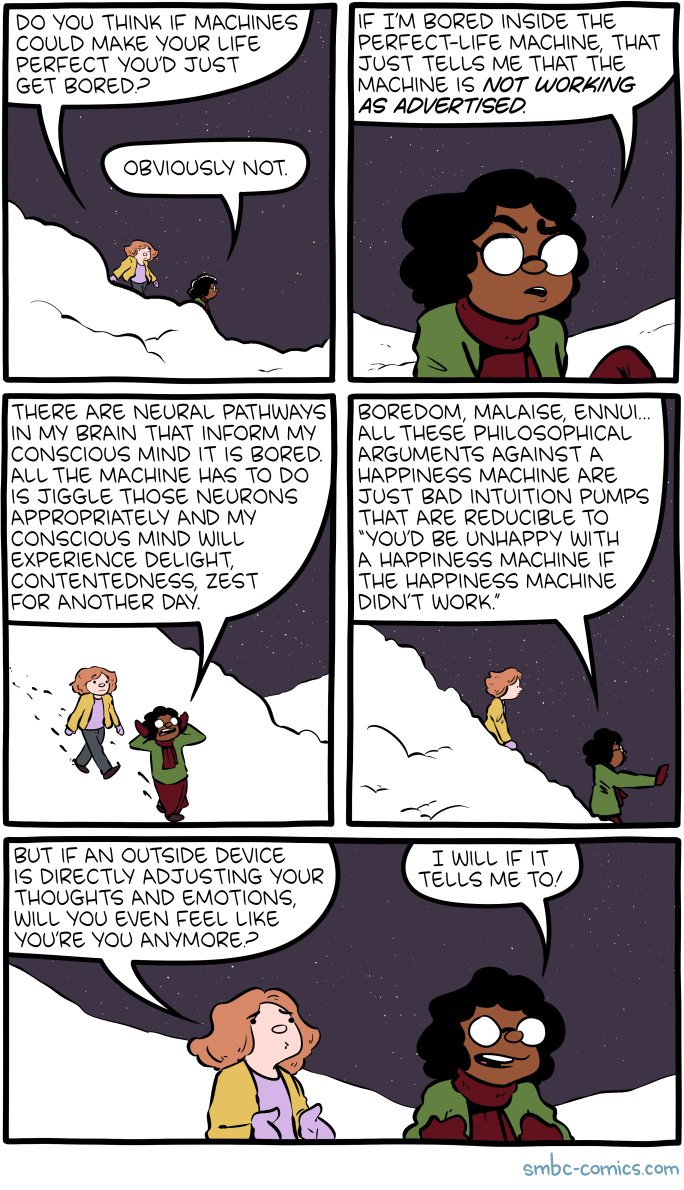
This comic presents a philosophical thought experiment about happiness machines. Two characters are hiking in a snowy mountain setting, and one asks: "Do you think if a machine could make your life perfect, you'd just get bored?" The other responds: "Obviously not."
The comic then walks through a careful philosophical argument. There are "neural pathways" and reasons that happiness doesn't work that way -- the machine would need to give you things to do, make you feel appropriately challenged, and sustain your sense of contentment. The argument acknowledges that boredom, malaise, and ennui are themselves mental states that are reducible to neurochemistry, and therefore a sufficiently advanced happiness machine could simply prevent those states from arising.
The final panel delivers the twist: "But if an outside device is directly modifying your brain state to produce contentment, will you even feel like it's really you?" This question about authenticity and identity cuts to the heart of the philosophical problem -- even if we could be made perfectly happy by a machine, there's an open question about whether that happiness would be genuinely "ours."
This is a classic SMBC exploration of the "experience machine" thought experiment originally proposed by philosopher Robert Nozick in 1974. Nozick argued that most people would choose not to plug into a machine that simulates a perfect life, suggesting that we value things beyond just subjective experience -- like actually doing things, being a certain kind of person, and having contact with reality. The comic takes the argument seriously and explores it with genuine philosophical nuance rather than simply going for a quick joke, though the humor comes from the increasingly academic tone of what started as a casual hiking conversation, and from the uncomfortable realization that there may not be a satisfying answer to the question.