heap-problems
Explanation
The Joke
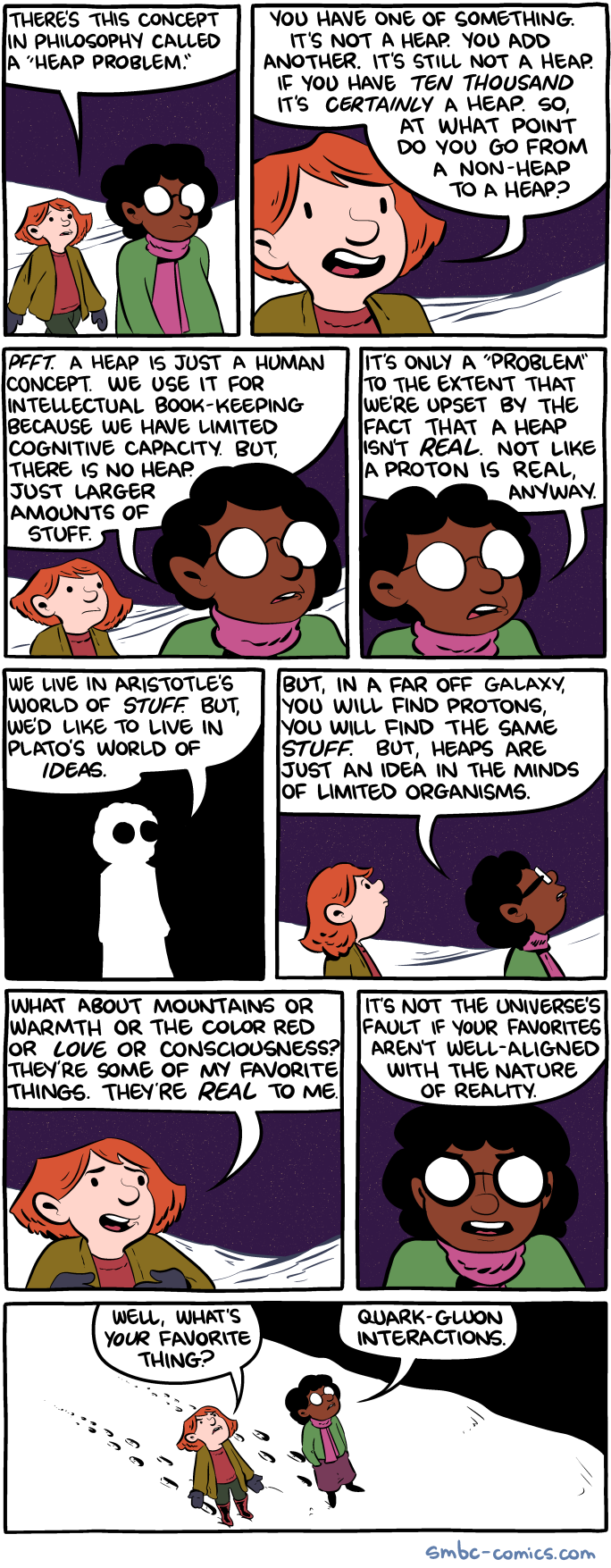
Two characters discuss the philosophical "heap problem" (the Sorites paradox): at what point does a collection of individual items become a "heap"? One grain of something is not a heap; add another, still not a heap — but ten thousand grains certainly is. So where is the boundary? A woman with glasses explains that a "heap" is just a human concept used for intellectual bookkeeping because we have limited cognitive capacity — there is no real threshold, just larger amounts of stuff. She argues that heaps are not real the way a proton is real. The other character asks about mountains, warmth, the color red, love, and consciousness — noting these are some of their favorite things and they feel real. The woman replies that it is not the universe''s fault if your favorites are not aligned with the nature of reality. When asked what her favorite thing is, she answers: "Quark-gluon interactions."
The Humor
The comic plays on the gap between how humans experience the world and how reality actually works at a fundamental level. The woman represents a strict reductionist or eliminative materialist position — she argues that macro-level concepts like "heaps," "mountains," "warmth," and even "love" and "consciousness" are merely useful fictions that our brains create because we cannot process reality at the quantum level. The punchline is that her favorite thing — quark-gluon interactions — is something that actually exists at the most fundamental level of physics, but is completely unrelatable and unenjoyable as a human experience. The humor comes from the absurdity of someone who has so thoroughly committed to this philosophical position that they have forsaken all normal human pleasures in favor of appreciating subatomic particle interactions.
References
The Sorites paradox (or "heap problem") is one of the oldest puzzles in philosophy, attributed to Eubulides of Miletus (4th century BCE). It concerns vague predicates and the difficulty of drawing precise boundaries for concepts that exist on a continuum. Quark-gluon interactions refer to the strong nuclear force in quantum chromodynamics (QCD), where gluons mediate the interactions between quarks inside protons and neutrons. The reference to living in "Aristotle''s world" versus "Plato''s world of ideas" alludes to the longstanding philosophical debate between empiricism (Aristotle) and idealism (Plato).