heartbeats

Explanation
The Joke
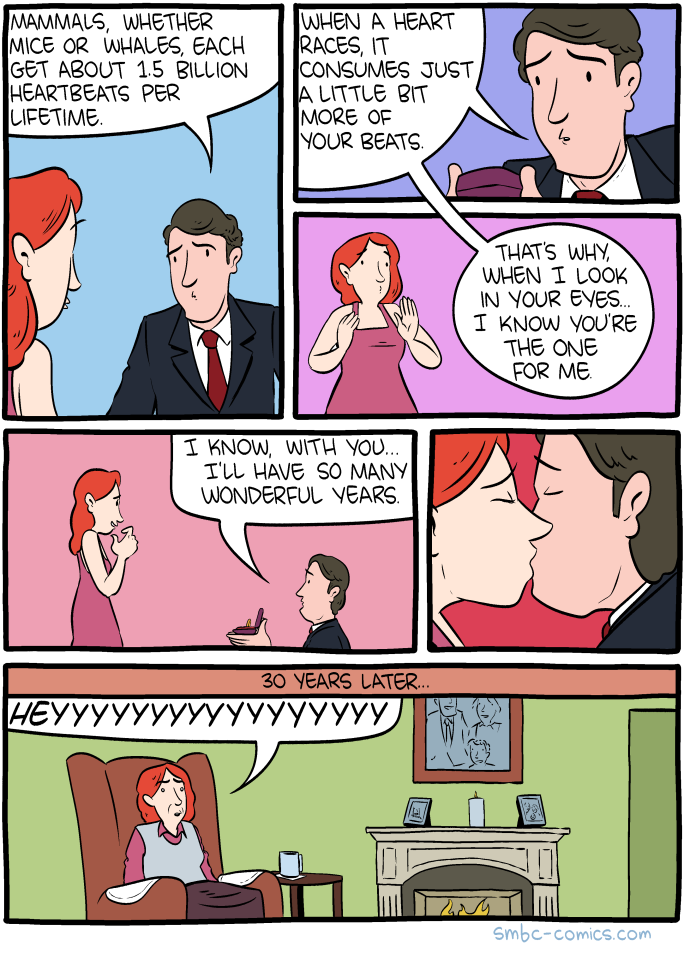
The comic opens with a romantic scenario: a man tells a woman a poetic-sounding fact -- "Mammals, whether mice or whales, each get about 1.5 billion heartbeats per lifetime, just allocated at different rates." This sounds like a beautiful meditation on the universality of life. The woman begins to respond romantically: "Let's say, then, I look in your eyes. I know you're the one because --" but the man cuts her off with a horrifying extrapolation: "If you're with me, I'll have so many unanswered emails."
In the final panel, a couple is sitting apart in what appears to be a therapist's office or living room, and one says something like "Heyyyy" in an exasperated tone, suggesting the romantic moment was thoroughly ruined. The man took a poetic observation about heartbeats and lifespan and, instead of leaning into the romance, pivoted to anxiety about productivity and how spending time with a partner means falling behind on email.
The Humor
The comedy comes from the brutal deflation of a romantic moment with mundane modern anxiety. The "1.5 billion heartbeats" fact is genuinely beautiful and frequently cited in popular science as a meditation on mortality and the preciousness of time. The expected romantic follow-through ("you're the one") gets derailed by the logical but deeply unromantic conclusion that every heartbeat spent on love is a heartbeat not spent on inbox management. It's a sharp satire of the modern tendency to quantify everything, including relationships, in terms of productivity and opportunity cost.
References
The observation that most mammals get roughly the same number of heartbeats in a lifetime (approximately 1-1.5 billion) is a real biological scaling law. Smaller animals have faster heart rates but shorter lifespans, while larger animals have slower heart rates but live longer, so the total number of heartbeats is roughly constant across species. This relationship was explored by researchers like Max Kleiber and is related to allometric scaling laws in biology.