heaven-2
Explanation
The Joke
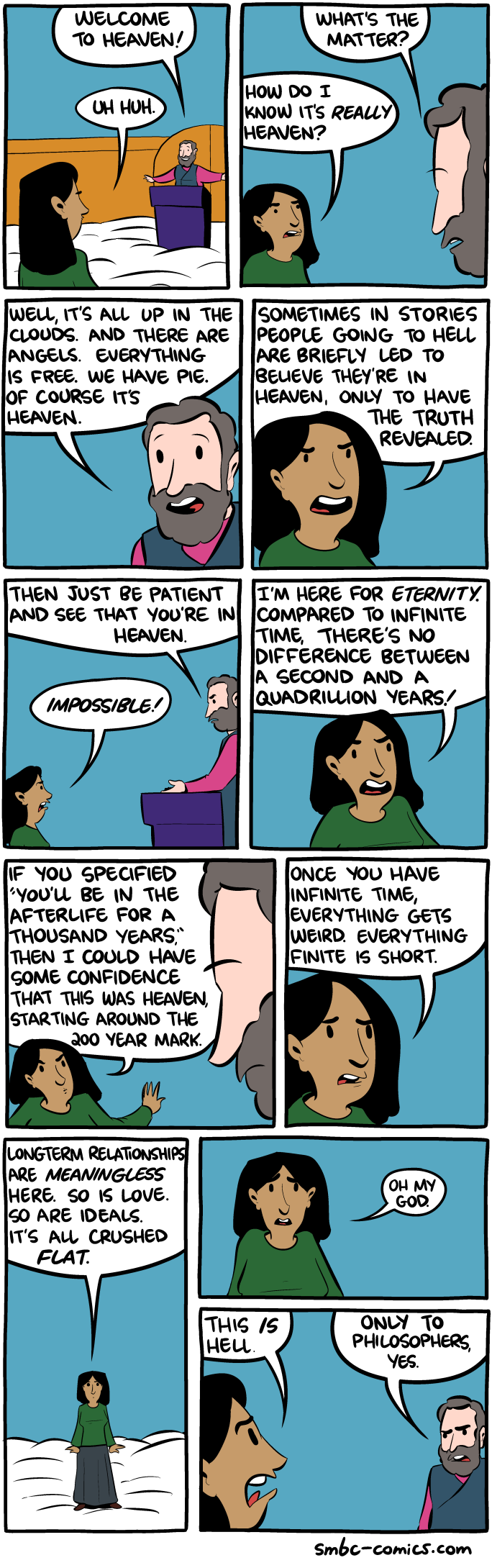
A woman arrives at the gates of heaven, greeted by a bearded figure (presumably Saint Peter or God) who says "Welcome to heaven!" She immediately questions it: "How do I know it's really heaven?" The greeter explains all the standard heavenly features -- clouds, angels, free pie -- but the woman counters with a clever philosophical objection: "Sometimes in stories people going to hell are briefly led to believe they're in heaven, only to have the truth revealed."
The greeter tries to reassure her: "Then just be patient and see that you're in heaven." But the woman delivers the devastating logical blow: "I'm here for eternity compared to infinite time. There's no difference between a second and a quadrillion years!" She points out that in an infinite timeline, any finite period of happiness is essentially zero, so she can never be sure she is not in a temporary heaven-phase of hell. The greeter then says that if she had specified she would be in the afterlife for only a thousand years, he could have confirmed it was heaven starting around the 300-year mark. He adds that with infinite time, everything finite seems short, and that long-term relationships are meaningless because everything is equally close to zero -- all are "crushed flat."
The final panel reveals the punchline: "This is hell." A bearded man nearby says "Only to a philosopher," revealing that the philosophical torment of being unable to verify one's own eternal happiness IS the punishment.
The Humor
The comedy works by turning a common religious thought experiment into a rigorous philosophical problem. The woman's objection is genuinely clever -- if you have infinite time ahead of you, any finite sample of experience tells you nothing about the overall nature of your eternity. Weinersmith is playing with concepts from philosophy of mind and decision theory, particularly the problem of induction in infinite scenarios. The final twist that this IS hell, but "only to a philosopher," is a double joke: it suggests that philosophers are uniquely tortured by logical problems that would not bother anyone else, and that the worst possible hell for a philosopher is an unsolvable epistemological puzzle.
References
- The comic draws on the philosophical problem of verifying infinite claims with finite evidence, related to the problem of induction discussed by David Hume.
- The "false heaven" trope appears in various religious and literary traditions, notably in stories about demons deceiving the recently deceased.
- The concept that infinite time renders all finite durations meaningless connects to mathematical ideas about limits and measure theory, where finite values are negligible compared to infinity.