history-books
Explanation
The Joke
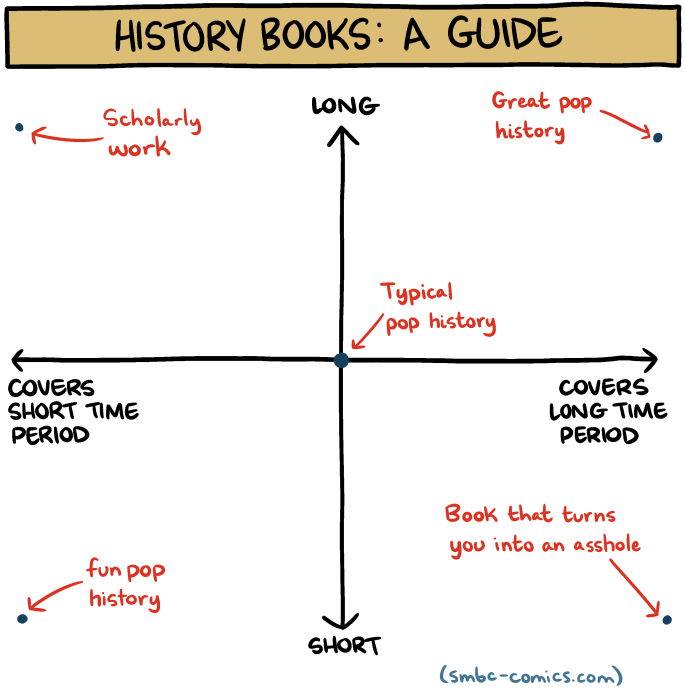
The comic presents a two-axis chart titled "History Books: A Guide." The vertical axis represents book length (short to long) and the horizontal axis represents the time period covered (short to long). The four quadrants are labeled as follows:
- Upper left (long book, short time period): "Scholarly work"
- Upper right (long book, long time period): "Great pop history"
- Center (medium length, medium time period): "Typical pop history"
- Lower left (short book, short time period): "Fun pop history"
- Lower right (short book, long time period): "Book that turns you into an asshole"
The Humor
The joke is in the lower-right quadrant. A short book that purports to cover a vast sweep of history (all of civilization, the entire arc of human progress, etc.) is, by necessity, so reductive and oversimplified that the reader comes away with dangerously confident but shallow opinions about complex historical phenomena. These are the kinds of books that lead people to make sweeping pronouncements at dinner parties about why civilizations rise and fall, armed with a superficial framework they mistake for deep understanding. The chart cleverly captures a real phenomenon in popular nonfiction: the shorter the book and the grander the scope, the more likely it is to produce readers who are insufferably certain about things they barely understand.