history-is-weird
Explanation
The Joke
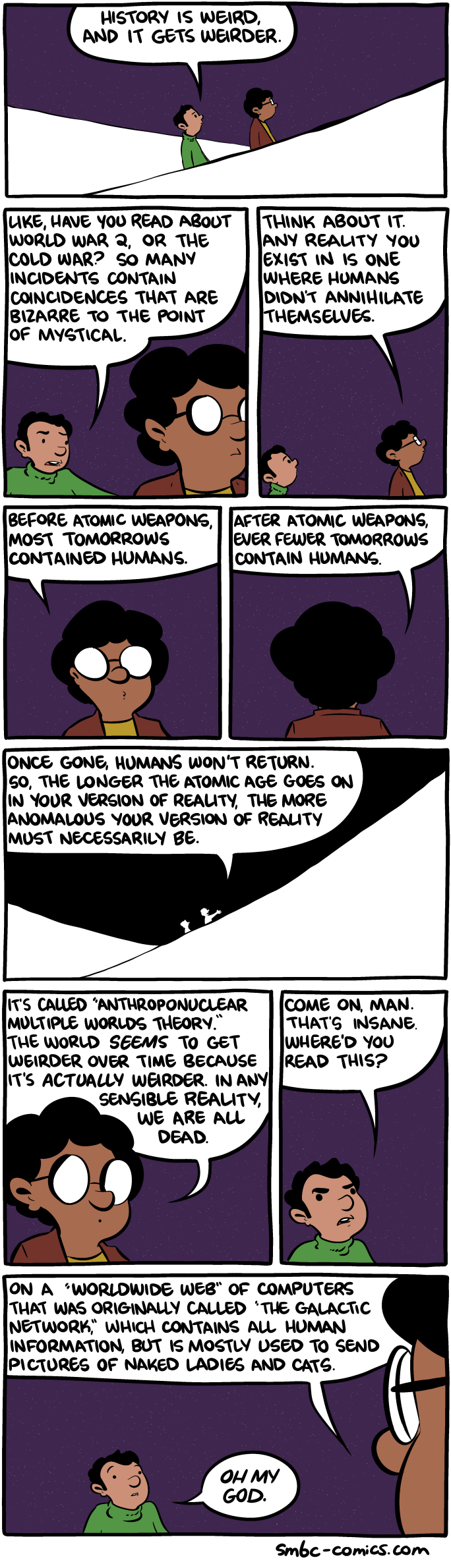
The comic opens with the statement "History is weird, and it gets weirder." A character then observes that when you read about World War 2 or the Cold War, many incidents contain coincidences that are "bizarre to the point of mystical." The comic then presents a thought experiment rooted in nuclear war: "Before atomic weapons, most tomorrows contained humans. After atomic weapons, our future tomorrows contain humans" less certainly. The argument continues: once humans launch nuclear weapons and do not return, the longer the atomic age goes on without annihilation, the more anomalous your version of reality must necessarily be. This is framed as the "thermonuclear multiple worlds theory" — the world seems to get weirder over time because "it's actually weirder in any single reality. We are all dead." The final panel reveals that this conversation is taking place "on a worldwide web of computers that was originally called 'the galactic network,' which contains all human information but is mostly used to send pictures of naked ladies and cats."
The Humor
The comic takes the quantum mechanics "many-worlds interpretation" and applies it to nuclear annihilation. The argument goes: if nuclear war was probable, then in most branches of the multiverse, humanity was destroyed. The branches where we survive are, by definition, the statistically unlikely ones — which means our timeline should be full of improbable coincidences and bizarre events, because we are living in one of the "weird" surviving branches. The humor comes from this being used to explain why history seems so strange, and the final panel grounds the absurdity by pointing out that we live in a world where the most powerful information network ever created is primarily used for pornography and cat pictures — which does indeed seem like something that would only happen in a bizarre, improbable timeline.
References
- Many-Worlds Interpretation (MWI): A quantum mechanical interpretation proposed by Hugh Everett III in 1957, which holds that all possible outcomes of quantum measurements are realized in separate branching universes.
- Quantum immortality: A related thought experiment suggesting that a conscious observer always finds themselves in a branch where they survive, no matter how improbable.
- The "Galactic Network": J.C.R. Licklider's early 1960s concept of a globally interconnected set of computers, which influenced the development of ARPANET and eventually the Internet.
- The observation about the Internet being used for cats and adult content: A well-known cultural observation that satirizes the gap between the Internet's grand potential and its most popular actual uses.