holy-2
Explanation
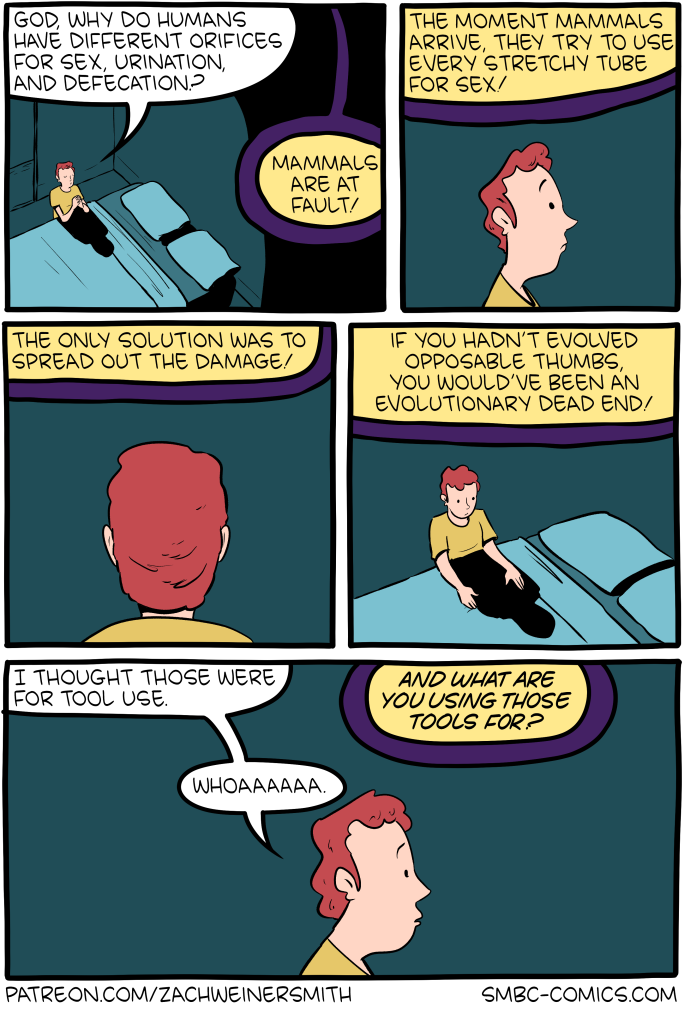
This comic presents a conversation between God and a human about the design flaws of mammals, particularly regarding the use of a single opening for both eating and breathing.
In the first panel, the human asks God why mammals were designed so that choking on food is possible — specifically referencing the shared pharynx used for both swallowing and breathing. God's response in the second panel is that mammals are essentially a work-in-progress: "Mammals are at beta at best." This frames biological evolution as a kind of software development process, where species are released before being fully debugged.
The human then asks about the "only solution" being to spread out the damage, to which God responds with an admission that the human has found opposable thumbs — described as a workaround rather than a true fix, and that this evolutionary path might be a dead end. The final panel reveals the ironic kicker: the human asks what those opposable thumbs are being used for, implying that the very tool God considers a flawed compromise has become humanity's defining advantage (tool use, technology, civilization).
The humor works through the conceit of treating God as an incompetent software developer or engineer who shipped a product with known bugs. The "beta" terminology is borrowed from software development, where "beta" refers to a product that is functional but still has unresolved issues. The comic plays on the real anatomical fact that the human pharynx serves dual duty for breathing and swallowing — a genuine design flaw from an engineering perspective that causes thousands of choking deaths annually. Evolutionary biologists often point to this as evidence against "intelligent design," since no competent engineer would route two critical systems through the same tube. The punchline about opposable thumbs being a "dead end" is funny because it is so spectacularly wrong in hindsight — opposable thumbs enabled tool use, which is arguably the single most important adaptation in human evolutionary history.