How
Explanation
The Joke
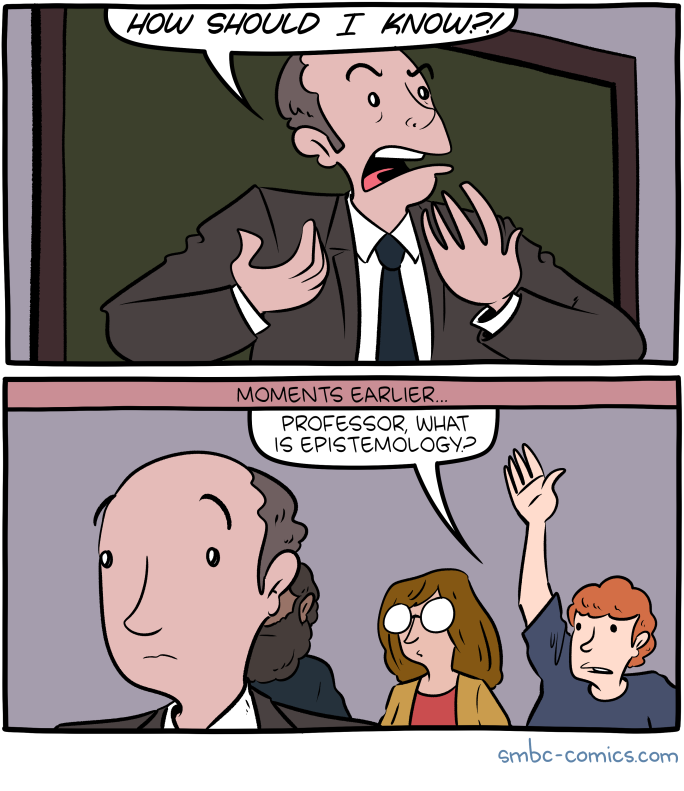
The comic shows a professor at a lectern who shouts "HOW SHOULD I KNOW?!" with an exasperated, panicked expression. The next panel is labeled "MOMENTS EARLIER" and shows a student in a classroom raising their hand and asking: "Professor, what is epistemology?"
The joke is that epistemology is the branch of philosophy that deals with the nature and scope of knowledge -- essentially, it asks "How do we know what we know?" So when the student asks "What is epistemology?", the professor's answer "How should I know?!" is simultaneously a frustrated outburst AND a perfectly valid epistemological response. The professor is, perhaps unintentionally, practicing what they teach.
The Humor
This is a classic example of a double-meaning joke. On one level, the professor appears to be incompetent or having a breakdown, unable to answer a basic question about their own field. On another level, "How should I know?" is actually a deep epistemological question -- it questions the very foundations of knowledge and how one can claim to "know" anything at all. The reversed timeline (showing the outburst before the question) enhances the comedy by first presenting the professor as unhinged, then recontextualizing the scene as an inadvertent philosophical demonstration. It's the kind of joke that rewards people who know what epistemology is, making it a perfect fit for SMBC's intellectually-oriented audience.
References
Epistemology is one of the major branches of philosophy, concerned with the theory of knowledge. It asks questions like: What is knowledge? How is knowledge acquired? What do people know? How do we know what we know? Famous epistemologists include Descartes (who questioned everything with "Cogito ergo sum"), David Hume, and Immanuel Kant. The professor's response inadvertently echoes epistemological skepticism -- the position that knowledge is impossible or at least fundamentally uncertain.