how-math-works
Explanation
The Joke
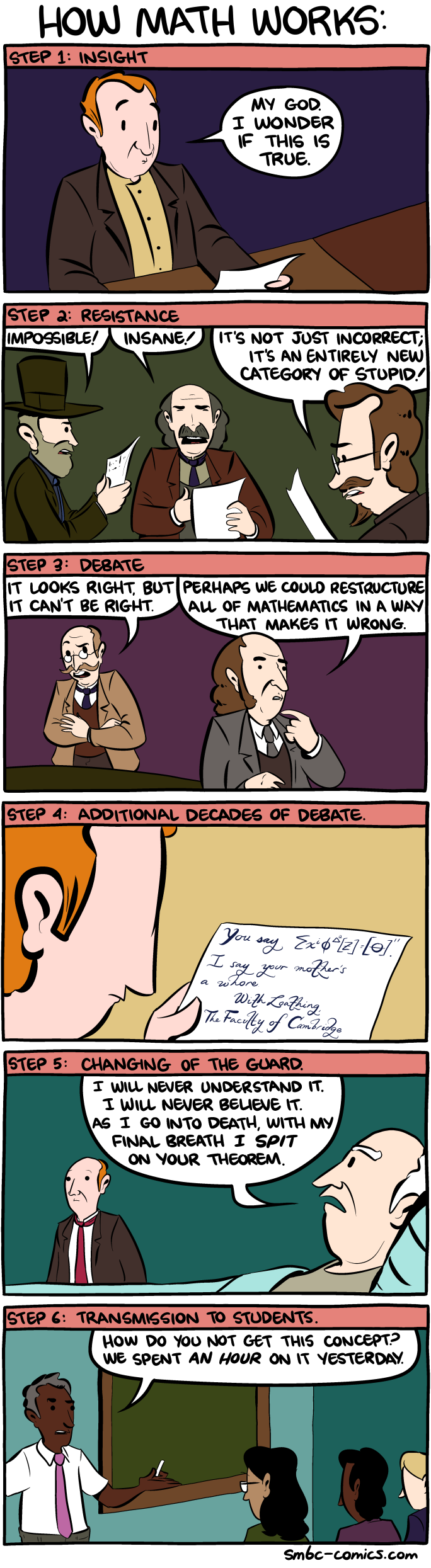
The comic presents a six-step process titled "How Math Works," depicting the lifecycle of a mathematical discovery from initial insight to its eventual transmission to students:
- Insight - A mathematician has a revelation: "My God, I wonder if this is true."
- Resistance - Peers react with hostility: "Impossible! Insane!" and "It's not just incorrect, it's an entirely new category of stupid."
- Debate - Grudging consideration: "It looks right but it can't be right" alongside "Perhaps we could restructure all of mathematics in a way that makes it wrong."
- Additional decades of debate - More mathematical arguments on a chalkboard.
- Changing of the guard - An older mathematician on his deathbed concedes: "I will never understand it. I was wrong because I was old. I go into death with my final breath: I spit on your theorem."
- Transmission to students - A professor berates a classroom: "How do you not get this concept? We spent an hour on it yesterday!"
The Humor
The comedy works on multiple levels. First, it satirizes the well-documented phenomenon in science and mathematics where revolutionary ideas face fierce resistance from the establishment before eventually becoming accepted orthodoxy. This mirrors Max Planck's famous observation that science advances "one funeral at a time" -- old guard scientists don't change their minds; they simply die and are replaced by a generation that grew up with the new ideas.
The punchline in Step 6 delivers the sharpest irony: a concept that took the brightest mathematicians decades of bitter argument to accept is now taught as something so basic that a professor is frustrated students can't grasp it after a single hour-long lecture. The professor has completely lost perspective on how genuinely difficult the material is, having internalized it as "obvious" -- the exact opposite of how the mathematical community originally received it.
References
The comic alludes to Max Planck's principle about scientific progress, sometimes paraphrased as "Science advances one funeral at a time." The history of mathematics is full of such examples -- non-Euclidean geometry, Cantor's set theory, and Galois theory all faced enormous resistance before becoming standard curriculum.