Humans are Amazing!
Explanation
The Joke
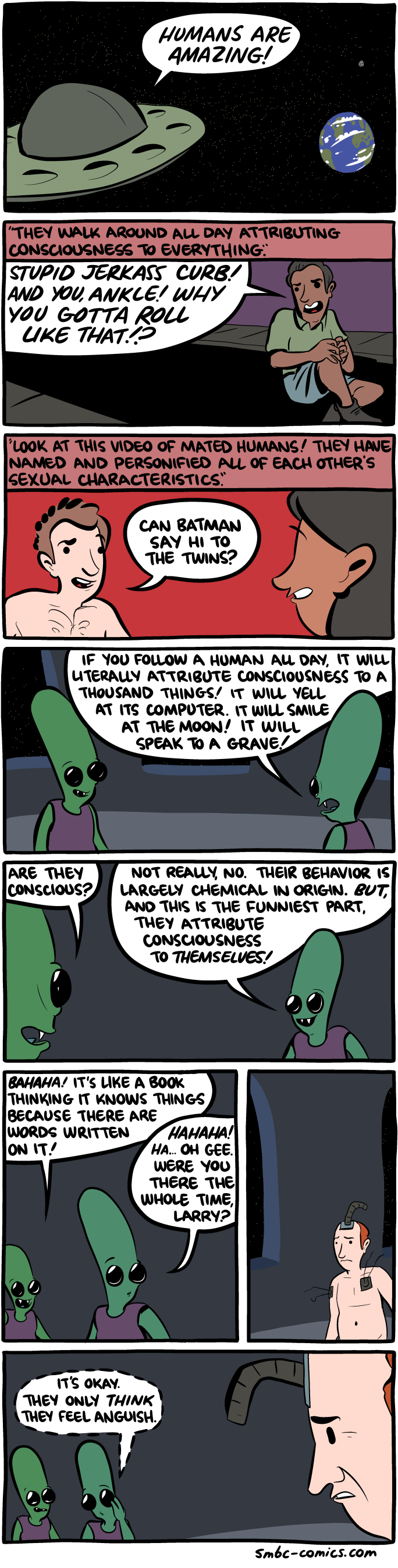
An alien is giving a presentation about humans, marveling at how "Humans are amazing!" The alien explains that humans walk around attributing consciousness to everything -- they yell at inanimate objects ("Stupid jerky curb! Why'd you have to be there?"), talk to their pets as though they understand, and even speak to graves. A video shows mated humans who have "named and personified all of each other's sexual characteristics" (with one asking "Can Batman say hi to the twins?").
When another alien asks if humans are actually conscious, the presenter clarifies that no, this behavior is "largely chemical in origin" and the "funniest part" is that "they attribute consciousness to themselves." The aliens find this hilarious, comparing humans to a book that is funny precisely because there are no characters aware of the joke.
In the final panel, one alien says it is okay because humans "only think they feel sadness."
The Humor
The comic sets up an expectation that the aliens are admiring human consciousness and empathy, but then pulls the rug out by revealing the aliens consider humans to be non-conscious beings who merely exhibit behaviors that mimic awareness. The biggest punchline is the reversal: the very trait humans pride themselves on most -- consciousness and self-awareness -- is treated by the aliens as the most amusing delusion of all.
The joke engages with genuine philosophical questions about consciousness (the "hard problem" of whether subjective experience is real or an illusion produced by chemical processes). The final line -- dismissing human sadness because they "only think they feel" it -- is darkly funny because it mirrors debates in philosophy of mind about whether the experience of feeling and the reality of feeling are distinguishable.
References
The comic references the philosophical concept of the "hard problem of consciousness" and the related idea of philosophical zombies (beings that behave as if conscious but have no inner experience). The joke about naming sexual characteristics ("Batman" and "the twins") parodies how humans personify body parts in intimate contexts.