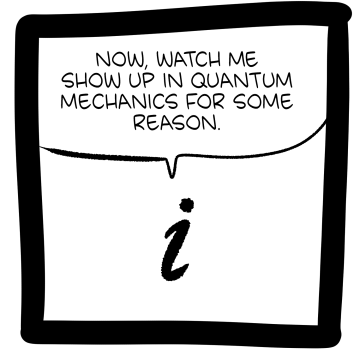
i
Explanation
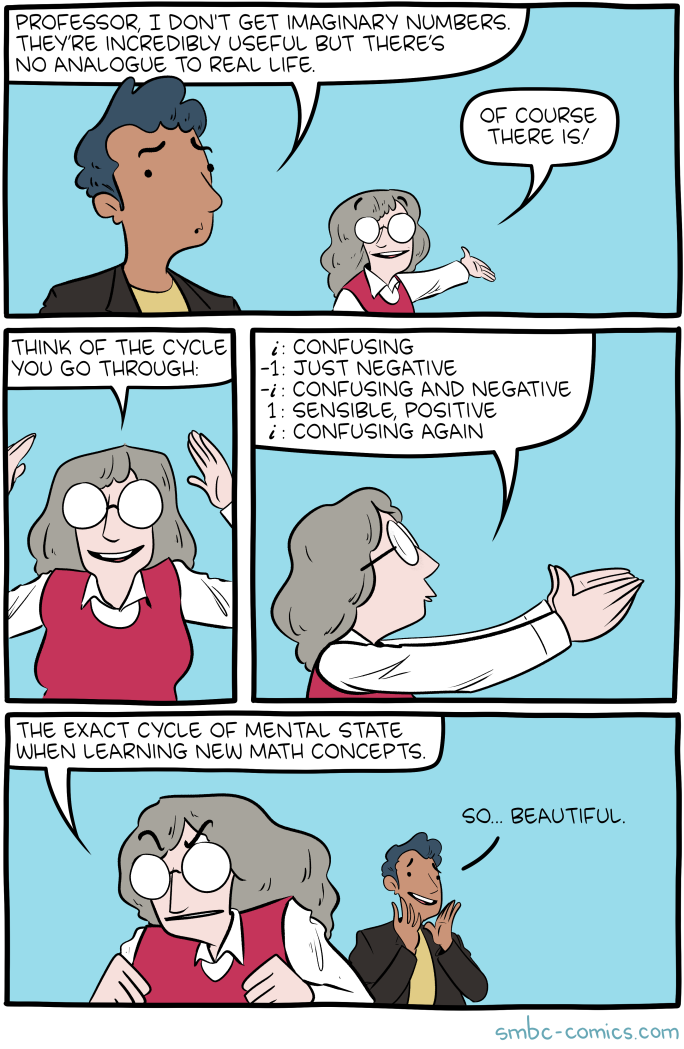
This comic is about the concept of imaginary numbers in mathematics, specifically the imaginary unit "i" (the square root of negative one).
In the first panel, a student complains to a professor: "Professor, I don't get imaginary numbers. They're weird made-up ideas, but there's no analogue to real life." The professor responds: "Of course there is."
In the second panel, the professor explains the cycle of powers of i: you go through the sequence of i, i squared (which equals -1), i cubed (which equals -i), and i to the fourth (which equals 1), and then the cycle repeats. She lists the emotional stages this maps onto:
1. Confused
2. Just negative
3. Confused AND negative
4. Sensible, positive
5. Confusing again
The third panel delivers the punchline: "The exact cycle of mental state when learning new math concepts." The student responds: "So beautiful."
The joke works on two levels. First, the mathematical cycle of powers of i (i, -1, -i, 1, repeating) is a real and important property of imaginary numbers. Second, the comic maps this cycle onto the emotional experience of learning mathematics: initial confusion, then feeling negative about it, then being both confused and negative, then finally having a breakthrough moment of clarity -- only for the cycle to repeat with the next concept. The student's awed response ("So beautiful") is itself an example of stage 4 (sensible, positive) and implies that stage 1 (confusion) is just around the corner again.
The comic is a playful defense of imaginary numbers, arguing that they do have a "real life" analogue -- just not in the way the student expected.