i-love-you
Explanation
The Joke
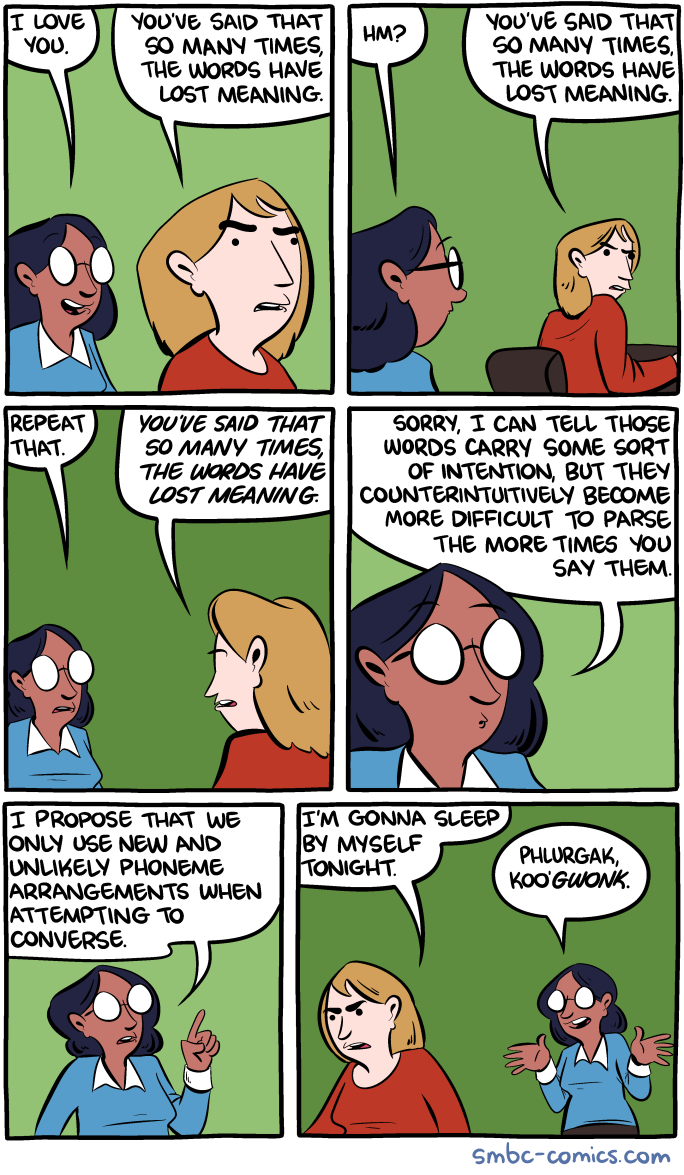
A man says "I love you" to a woman. She replies that he has said that so many times the words have lost their meaning. He asks her to repeat that, and she says: "You have said that so many times the words have lost meaning." He responds: "Sorry, I can tell those words carry some sort of intention, but they counterintuitively become more difficult to parse the more times you say them." She then proposes that they should use unlikely phoneme arrangements when attempting to communicate genuine emotion, and proceeds to say a nonsensical word. He responds with another nonsensical word as well.
The Humor
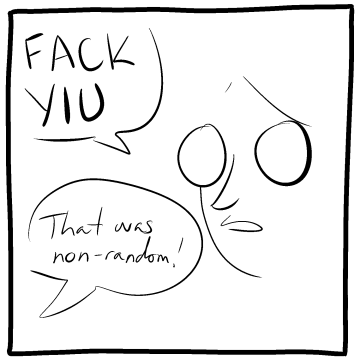
The comic takes the common relationship complaint — that saying "I love you" too often makes the phrase lose its meaning — and applies the same logic recursively. When she complains that his words have lost meaning through repetition, he points out that her complaint has also become meaningless through its own repetition. This creates a paradox: if repetition drains meaning from words, then repeatedly complaining about that phenomenon is equally subject to semantic satiation. The proposed solution — using random, unlikely phoneme arrangements — is absurd but logically consistent within the comic''s framework: if familiar phrases lose meaning, then unfamiliar nonsense words would retain maximum emotional impact. The humor lies in watching a communication problem about communication spiral into increasingly absurd meta-levels.
References
The phenomenon described is related to "semantic satiation," a psychological phenomenon where repetition causes a word to temporarily lose meaning for the listener. The concept was formally studied by Leon Jakobovits James in his 1962 doctoral dissertation. The idea of using novel phoneme arrangements playfully touches on concepts from information theory, where unexpected signals carry more information content than expected ones.