if-you-love-someone-set-them-free
Explanation
The Joke
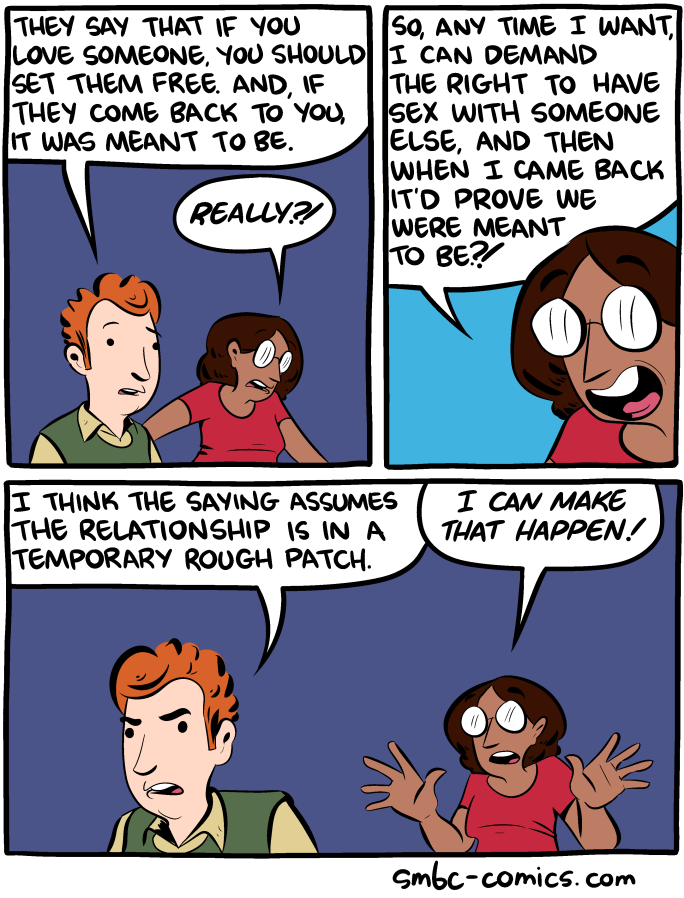
A man explains the old saying to his partner: "They say that if you love someone, you should set them free, and if they come back to you, it was meant to be." He then offers his interpretation: "So any time I want, I can demand the right to have sex with someone else, and then when I come back it'll prove we were meant to be!"
His partner says, "Really?" The man responds enthusiastically: "I think the saying assumes the relationship is in a temporary rough patch." His partner replies: "I can make that happen!" -- implying she is about to create a very permanent rough patch (i.e., break up with him or worse).
The Humor
The comedy comes from the man's willful misinterpretation of a romantic platitude to justify infidelity. The saying "If you love someone, set them free" is meant to be about trust and non-possessiveness -- the idea that genuine love does not need to cling or control. The man twists this into a logical argument for an open relationship or cheating, using the romantic saying as a rhetorical loophole.
His partner's response is the punchline: when he says the saying assumes a "temporary rough patch," she cheerfully agrees to create one -- but the implication is that her version of a "rough patch" will be the end of the relationship entirely, not the temporary freedom he was hoping for. The humor lies in his obliviousness to the fact that his clever argument is about to backfire spectacularly.
References
"If you love somebody, set them free" is a widely known proverb, also the title of a 1985 hit song by Sting. The full saying is typically rendered as: "If you love someone, set them free. If they come back, they're yours; if they don't, they never were." It is often attributed to various sources, though its exact origin is uncertain.