immortality-2

Explanation
The Joke
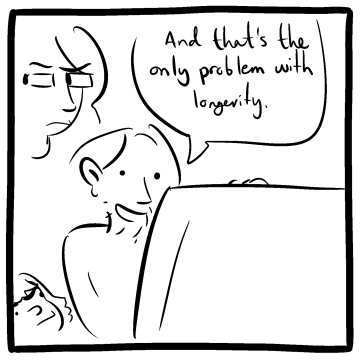
A group of people discusses whether immortality would be desirable. The conversation spirals through increasingly elaborate philosophical objections: you would eventually get bored, your personality would change so much over infinite time that the future "you" would essentially be a different person, the heat death of the universe would leave you floating in darkness forever, and you might end up in a repetitive existence. Each time someone raises an objection, someone else refutes it or adds a new layer of complexity. The discussion becomes so convoluted and exhausting that at the end, one person declares: "I am going to kill myself just to avoid ever having this conversation again." Another responds: "Strange, that is also what happened to the last immortal." The final panel shows a lone figure standing under the stars, suggesting the vast loneliness of the truly immortal being who presumably ended their own existence for similar reasons.
The Humor
The comic satirizes the well-worn philosophical debate about whether immortality would be desirable -- a topic that philosophy students and science fiction fans have rehashed endlessly. The joke is that the debate itself is so tedious and circular that it becomes its own argument against living forever: if you were immortal, you would have to endure this exact conversation an infinite number of times. The punchline -- that the last immortal killed themselves not out of existential despair but to escape this specific discussion -- deflates all the grandiose philosophical arguments by suggesting the real unbearable aspect of eternal life is not cosmic horror but banal social interactions. The final image of a solitary figure under the stars adds a bittersweet coda that works both as genuine pathos and as a visual punchline.
References
The comic engages with longstanding philosophical arguments about immortality, particularly those associated with Bernard Williams''' influential 1973 essay "The Makropulos Case: Reflections on the Tedium of Immortality," which argued that eternal life would eventually become unbearably boring. The heat death of the universe is a real cosmological prediction in which the universe reaches maximum entropy and all activity ceases.