immortalization
Explanation
The Joke
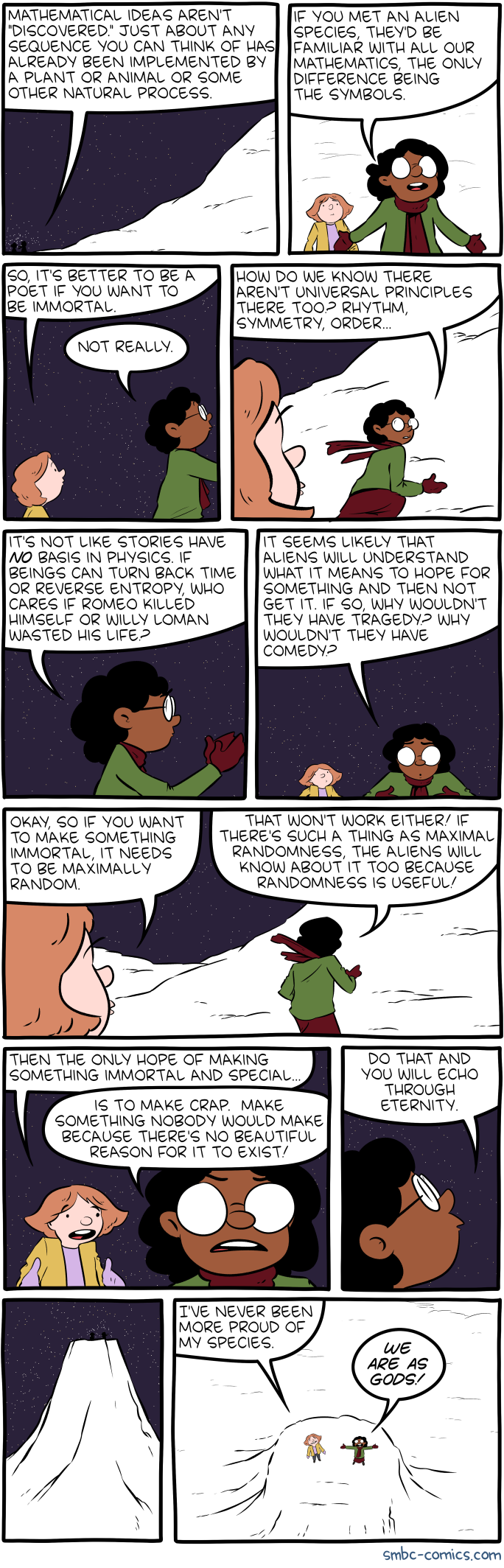
Two people are lying in bed having a late-night conversation about immortality. One observes that "mathematical ideas aren't considered 'just about any sequence you can think of' -- nobody has implemented it as a plant or animal or some other natural process." The discussion turns to whether it is better to be immortal, and the other person replies "not really."
The conversation then goes deeper into what it would take to make something truly immortal. They discuss aliens: if you met an alien species familiar with all our mathematics, the difference would be in the symbols, not the concepts. They reason that things like stories can be retold and altered, making them impermanent -- even Shakespeare's works change over time. They consider randomness as a strategy, but conclude that aliens would also discover randomness, so it is not unique enough to be immortalizing.
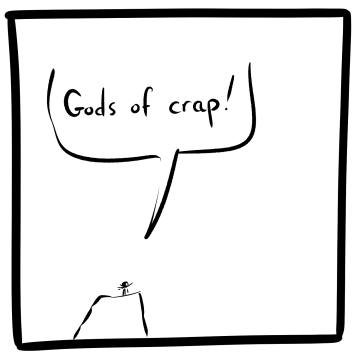
The conversation reaches its conclusion: the only way to make something immortal and special is to make "something nobody would make -- something so weird there is no particular reason for it to exist." The final panel shows the two characters looking at each other, and one says: "I've never been more into my species," with the other replying: "Are we as good as Gods?" The implication is that humanity itself -- strange, purposeless, and improbable -- is the ultimate immortal creation precisely because nothing about us is mathematically necessary.
The Humor
The humor builds slowly through a philosophical argument that starts with abstract questions about immortality and mathematics, and ends with the surprisingly touching (and funny) conclusion that the best argument for humanity's cosmic significance is that we are so bizarre and unnecessary that no other civilization would independently invent us. It is a backhanded compliment to the human race: we are immortal not because we are great, but because we are inexplicably weird. The pillow-talk setting adds comedy, as this is an absurdly heavy conversation for two people trying to fall asleep.
References
The comic touches on mathematical Platonism (the idea that mathematical truths exist independently of human discovery), the concept of convergent evolution (whether alien civilizations would arrive at the same discoveries), and questions about what makes human culture unique versus universal. It also plays with the fine-tuning argument, but inverts it: instead of asking why the universe is fine-tuned for us, it asks what about us could not be derived from first principles.