Imposter
Explanation
The Joke
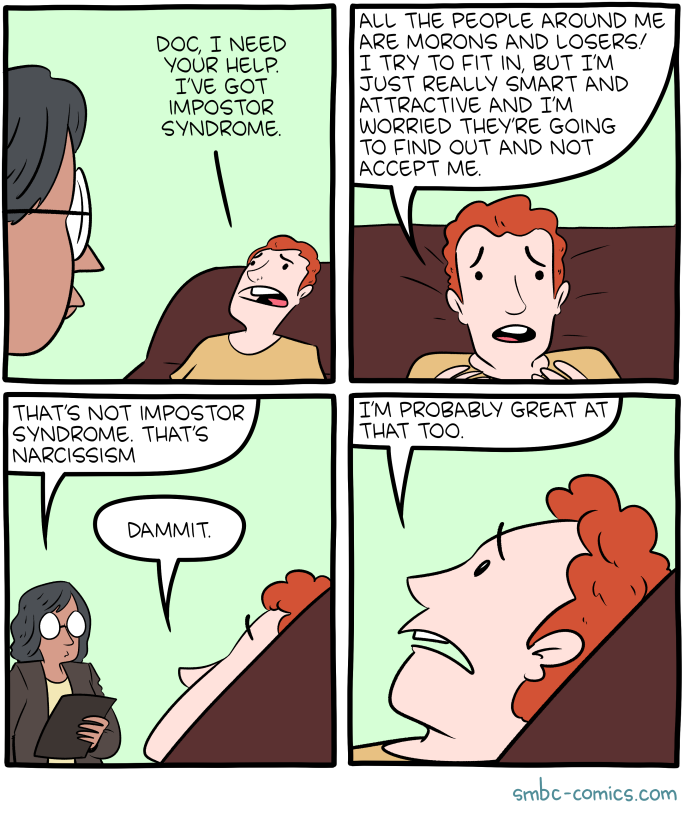
A red-haired man visits a therapist and announces: "Doc, I need your help. I've got impostor syndrome." He then describes his situation: "All the people around me are morons and losers! I try to fit in, but I'm just really smart and attractive and I'm worried they're going to find out and not accept me." The therapist responds: "That's not impostor syndrome. That's narcissism." The man says "Dammit" -- and then, in the final panel, leans in smugly and says: "I'm probably great at that too."
The joke is a perfect self-reinforcing loop: the man's narcissism is so deeply ingrained that even when he is diagnosed as a narcissist, he cannot help but turn the diagnosis itself into a source of self-congratulation. He literally cannot receive negative feedback without filtering it through his grandiose self-image.
The Humor
The comedy relies on a clever inversion of impostor syndrome. Real impostor syndrome involves feeling like a fraud despite being competent -- this man has the exact opposite problem, believing he is superior despite (presumably) being ordinary. The final panel is the real kicker: the therapist's diagnosis of narcissism should be a wake-up call, but the narcissist's response -- "I'm probably great at that too" -- demonstrates the condition in real time. It is a joke that proves itself, where the punchline is also evidence of the diagnosis. The brief "Dammit" before the final line is perfectly timed, creating a moment where the reader thinks he might have accepted the feedback before he doubles down.
References
Impostor syndrome is a psychological pattern in which individuals doubt their accomplishments and have a persistent fear of being exposed as a "fraud," despite evidence of their competence. It was first described by psychologists Pauline Rose Clance and Suzanne Imes in 1978. Narcissistic personality disorder, by contrast, is characterized by grandiosity, a need for admiration, and a lack of empathy. The comic plays on the superficial similarity between the two -- both involve a mismatch between self-perception and reality -- while highlighting that they point in completely opposite directions.