inaccurate
Explanation
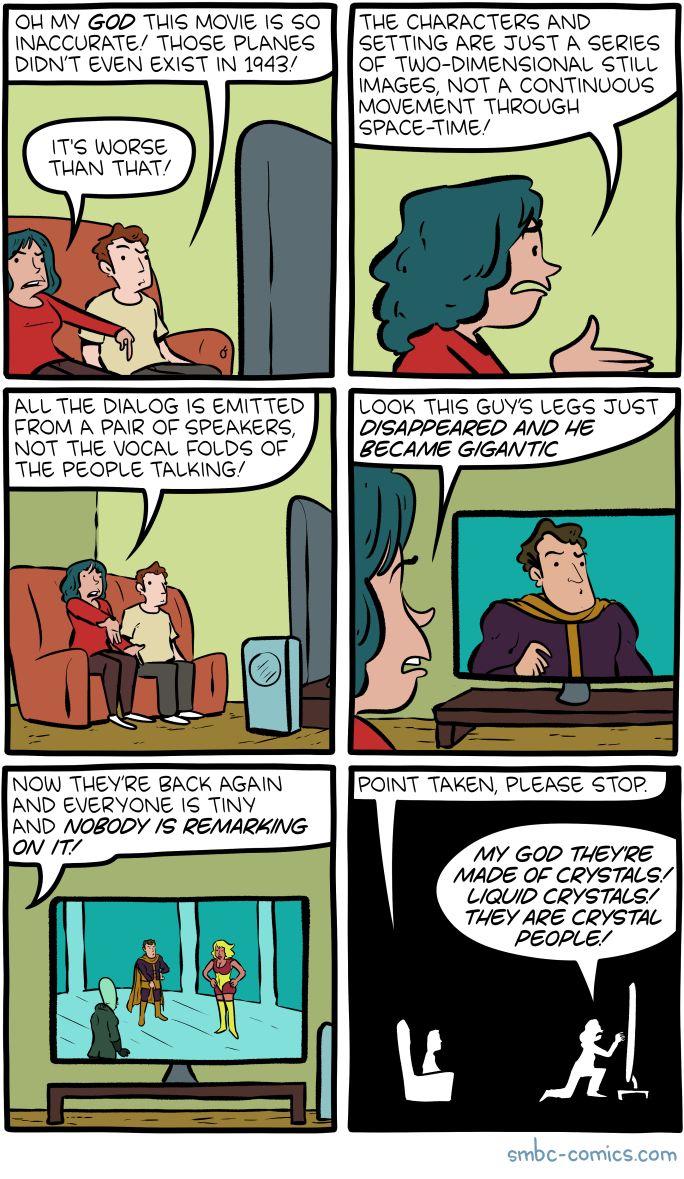
This comic features characters watching a movie and complaining about its inaccuracies. The first panel opens with someone exclaiming: "Oh my God, this movie is so inaccurate! These swords didn't even exist in this era!" Another character agrees: "It's worse than that!"
The complaints escalate: "The characters are just a series of two-dimensional images, not a continuous three-dimensional object moving through spacetime!" and "All the dialog is emitted from a pair of speakers rather than from the mouths of the people talking." Then: "These guys' legs just disappeared and they became gigantic" (referring to a close-up shot).
The final panels show them walking out of the theater saying: "Now then, back again, and everyone's shrinking and nobody is remembering" -- followed by "Don't even, please" and a final observation that the actors "are crystal clear" when in reality vision doesn't work that perfectly.
The joke takes the common habit of nitpicking historical or technical inaccuracies in movies and extends it to absurdity by pointing out the "inaccuracies" inherent in the medium of film itself. Movies are, by their nature, two-dimensional projections, sound comes from speakers rather than actors' mouths, close-ups distort scale, and the image is artificially sharp. These are all fundamental properties of cinema that audiences accept without thinking.
The humor satirizes pedantic movie critics who pride themselves on spotting anachronistic sword types or historically incorrect costumes, by showing that if you really committed to the principle of "this doesn't match reality," you'd have to reject the entire concept of film. It's a reductio ad absurdum of the "well, actually" impulse, suggesting that all fiction requires a baseline suspension of disbelief, and quibbling about which inaccuracies are acceptable is somewhat arbitrary.