infallible
Explanation
The Joke
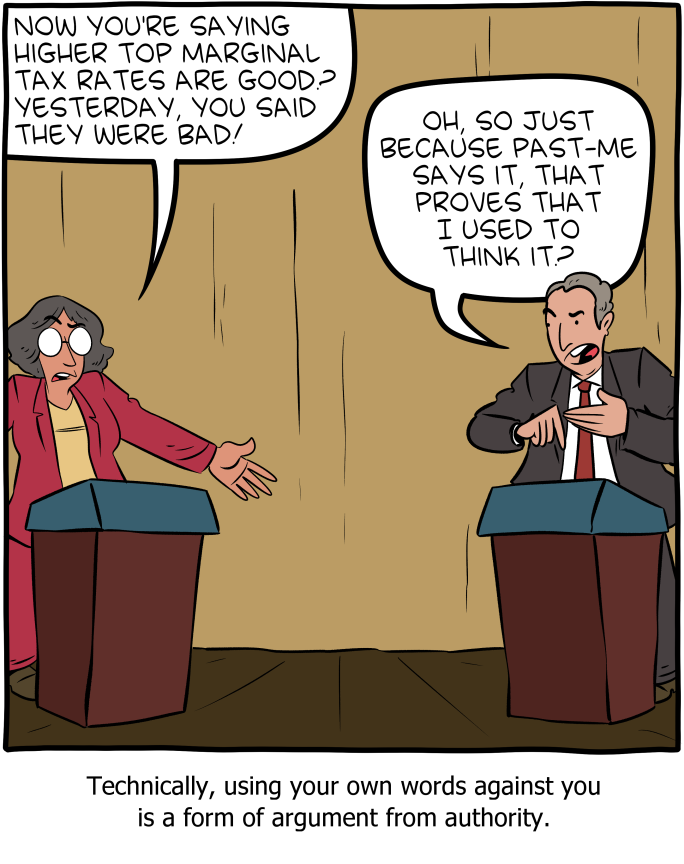
Two politicians are debating at podiums. A woman challenges her opponent: "Now you're saying higher top marginal tax rates are good? Yesterday you said they were bad!" The man responds indignantly, "Oh, so just because past-me says it, that proves that I used to think it?" Below the panels, the caption reads: "Technically, using your own words against you is a form of argument from authority."
The politician's defense is hilariously illogical -- he is essentially arguing that his own past statements do not constitute evidence of his past beliefs. This is an absurd attempt to dodge accountability for a flip-flop by treating his former self as a separate, unreliable person whose testimony should be disregarded.
The Humor
The joke operates on two levels. First, there is the sheer absurdity of a politician denying that his own recorded statements reflect what he once believed, taken to a ludicrous philosophical extreme. Second, the caption adds a layer of nerdy humor by invoking the logical fallacy of "argument from authority" -- the idea that citing an authority figure does not inherently prove a point. The joke is that the politician is so desperate to avoid being pinned down that he classifies his own past self as merely an "authority" whose views have no bearing on his current positions. It is a sharp satire of how politicians routinely contradict themselves and then find creative ways to explain away the contradiction.
References
The caption references the "argument from authority" (argumentum ad verecundiam), a well-known logical fallacy in which a claim is considered true simply because an authority figure endorses it. The comic humorously stretches this concept to its breaking point by suggesting that quoting someone's own words back at them is a form of this fallacy.