intelligence-2
Explanation
The Joke
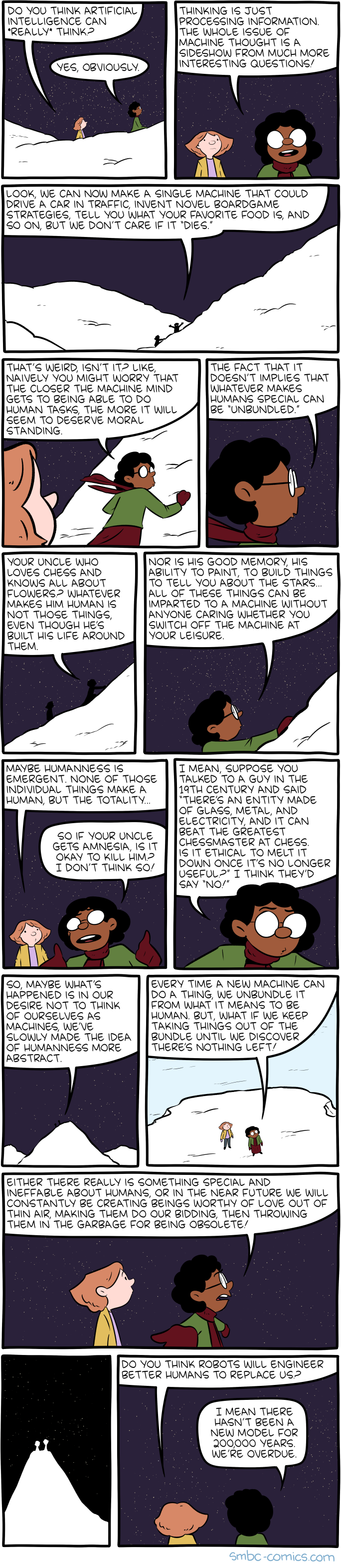
This long-form comic explores the concept of intelligence through a conversation between two characters, likely a parent and child or teacher and student, shown in a dark setting that suggests they are looking up at the stars or sitting in a cave. The discussion begins with one character asking what intelligence really is, and the other offering various definitions -- pattern recognition, problem-solving ability, adaptability.
As the conversation deepens, each proposed definition of intelligence is examined and found wanting. Animals can recognize patterns. Simple organisms adapt. Computers solve problems. The comic works through the philosophical difficulty of defining intelligence in a way that is both meaningful and not circular. Each attempt to pin down what makes humans uniquely intelligent gets undermined by counterexamples from nature or technology. The characters discuss whether intelligence might be about language, self-awareness, tool use, or abstract reasoning, but none of these criteria hold up as unique markers.
The comic concludes with a reflection that perhaps intelligence is not a single measurable trait but something more complex and context-dependent than we want to admit. The final panel delivers the punchline that despite all this philosophical exploration, we still use simple numerical scores (like IQ) to rank people's intelligence, reducing all that complexity to a single number.
The Humor
The humor builds through the Socratic structure of the dialogue -- each confident definition gets dismantled, creating a growing sense of intellectual vertigo. The comedy is in the gap between how casually we use the word "intelligent" in everyday life and how completely the concept falls apart under scrutiny. Weinersmith excels at this kind of philosophical comedy, where the joke is ultimately on humanity's confidence in concepts we cannot actually define. The visual setting -- characters dwarfed by darkness or vastness -- reinforces the theme of human smallness in the face of big questions.
References
The comic touches on longstanding debates in psychology, philosophy of mind, and artificial intelligence about how to define and measure intelligence. The concept of "general intelligence" (or Spearman's g factor) has been debated since the early 20th century. Howard Gardner's theory of multiple intelligences, the Chinese Room thought experiment, and the Turing Test are all part of this broader conversation about what intelligence means.