intrinsic
Explanation
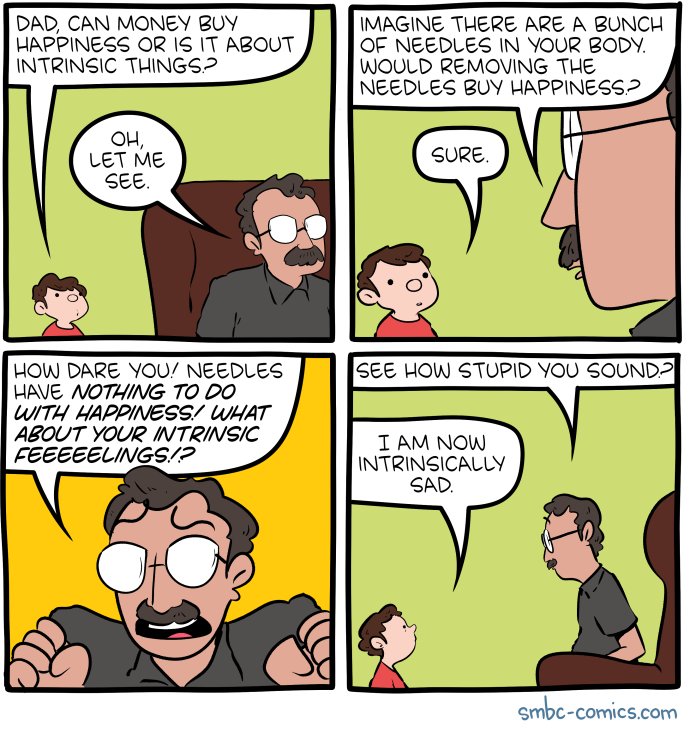
A child asks their father, "Dad, can money buy happiness, or is it about intrinsic things?" The father responds by asking the child to imagine a bunch of strangers deciding whether they would buy happiness. The child says "Sure" and the father says "See, how stupid you sound" -- pointing out that of course people would buy happiness if they could, making the question seem naive.
But then the child turns it around: "Now, that you've revealed you disagree with Aristotle, what about your marriage? What about your terrible feelings?" The father, caught off guard by the child weaponizing his own logic against him, concedes with "I am now intrinsically feeling terrible."
The joke operates on multiple levels. It satirizes the philosophical debate about whether happiness comes from external goods (money) or internal virtues (the Aristotelian view of eudaimonia). The father smugly dismisses the intrinsic-happiness position, but the child points out that the father's own life -- his marriage and emotional state -- suggests that money has not, in fact, bought him happiness, undermining his dismissal of the intrinsic view. The punchline "I am now intrinsically feeling terrible" is a double meaning: the father now intrinsically feels bad, which ironically proves the point that feelings are intrinsic after all.