intuition
Explanation
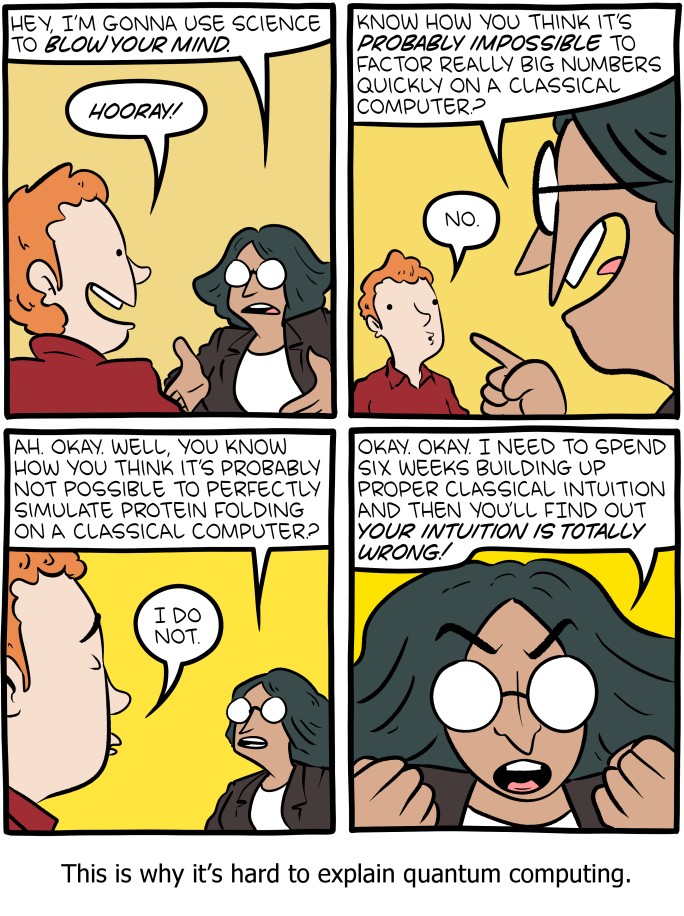
The comic is about the difficulty of explaining quantum computing to a general audience.
In the first panel, a scientist announces: "Hey, I'm gonna use science to blow your mind!" The audience cheers. The scientist then explains: "And now you think it's probably impossible to factor really big numbers quickly even on a classical computer!" The audience is unimpressed.
In the next panel, someone says: "Aw, buddy, you tried, but nobody knows you think it's probably not possible. It's probably a fiction on the classical computer." The scientist protests: "Why do I need to spend six weeks building up background intuition when your intuition is totally based..." The audience replies: "Cool, not interested."
The caption reads: "This is why it's hard to explain quantum computing."
The joke captures a genuine frustration in science communication. The impressive achievements of quantum computing, such as Shor's algorithm for factoring large numbers, are only impressive if you first understand why the problem is believed to be hard for classical computers. But most people have no intuition for computational complexity. They do not naturally appreciate that factoring large numbers is (believed to be) intractable for classical computers, so when you tell them a quantum computer can do it, the reaction is a shrug rather than astonishment.
It is analogous to the metaphor suggested in the comic: it is like telling someone who does not know about conservation of energy that you have a wheel that never stops spinning. Without the background knowledge that perpetual motion is supposed to be impossible, the claim is not impressive at all.
The comic satirizes the Catch-22 of science popularization: to convey why a result is exciting, you need the audience to first internalize the assumptions and background that make it surprising, but audiences want the exciting part immediately and have no patience for the prerequisite knowledge. This is particularly acute for quantum computing, where the popular narrative ("it tries all answers at once!") is misleading, and the actual explanation requires understanding computational complexity theory.