irrational-2

Explanation
The Joke
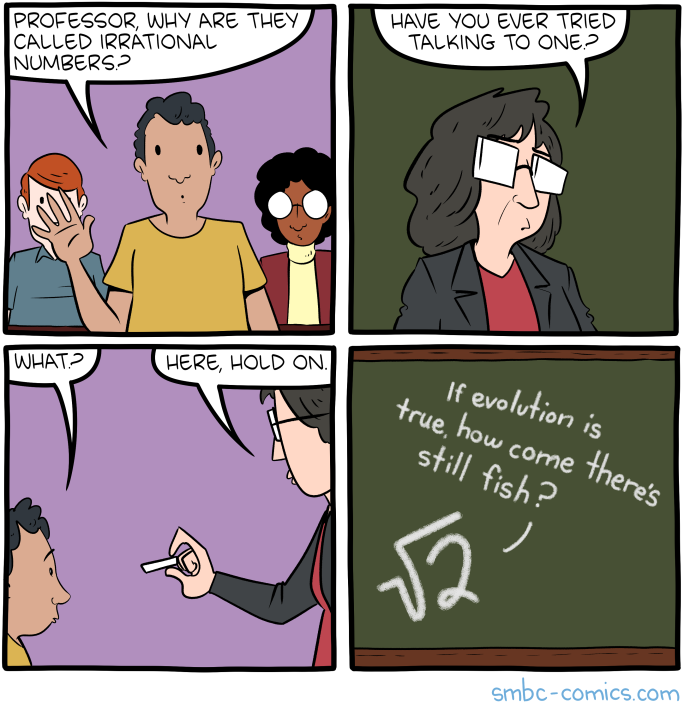
A student asks a professor, "Professor, why are they called irrational numbers?" The professor responds with "Have you ever tried talking to one?" When the student says "What? Here, hold on," the professor shows a chalkboard where the square root of 2 is saying "If evolution is true, how come there's still fish?" -- a notoriously bad anti-evolution argument.
The joke plays on the double meaning of "irrational." In mathematics, irrational numbers (like the square root of 2, pi, or e) are numbers that cannot be expressed as a simple fraction -- their decimal expansions go on forever without repeating. In everyday language, "irrational" means unreasonable, illogical, or not governed by reason. The comic literalizes the pun by depicting an irrational number making an irrational argument.
The Humor
The specific anti-evolution argument chosen -- "If evolution is true, how come there's still fish?" -- is a variant of the common creationist misunderstanding "If humans evolved from monkeys, why are there still monkeys?" This argument fundamentally misunderstands how evolution works (species evolve from common ancestors, not from currently existing species). By putting this famously bad argument in the mouth of the square root of 2, the comic creates a delightful double layer: the number is both mathematically irrational and intellectually irrational. The professor's weariness suggests this is not the first time they have had to deal with their numbers spouting nonsense.
References
The square root of 2 was historically the first number proven to be irrational, reportedly by the ancient Greek mathematician Hippasus, a member of the Pythagorean school. The "still fish" argument is a humorous twist on one of the most widely mocked misunderstandings of evolutionary biology.