irrational-3

Explanation
The Joke
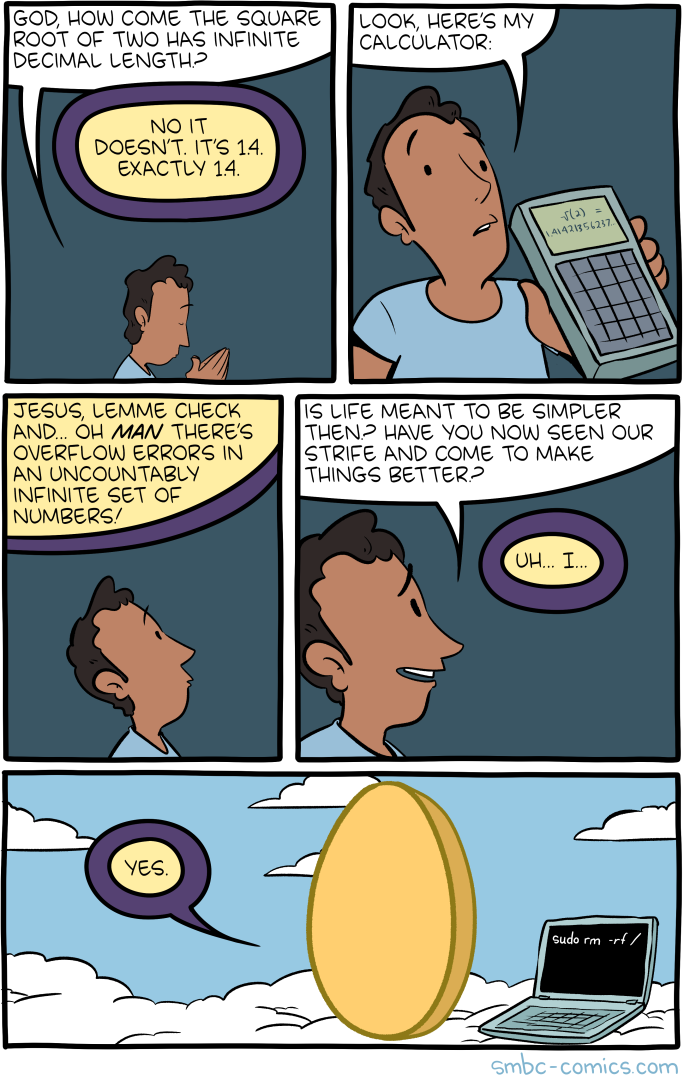
A person is looking at a calculator and exclaims: "God, how come the square root of two has infinite decimal length?" Someone else shows them a calculator and says, "Look, here's pi!" The first person protests: "No it doesn't! It's 1.4, exactly 1.4!" The scene then shifts to something grander -- perhaps a heavenly or cosmic setting -- where the character confronts God (or a divine figure), saying: "Jesus, leaving Greek and... oh man, there's an uncountably infinite set of irrational numbers!" The divine figure responds: "It was meant to be simpler. Since I have made you beings, our ethics are going to make things better." The person asks, "Yes?" and sees the answer "1.41..." trailing off.
The comic plays with the concept of irrational numbers and the human desire for neat, clean answers. The character is frustrated that the square root of 2 does not terminate, and when confronted with the vast reality of irrational numbers (which actually make up "most" of all real numbers), finds it philosophically distressing.
The Humor
The humor comes from treating the existence of irrational numbers as a cosmic design flaw rather than a mathematical fact. The character's insistence that the square root of 2 should be "exactly 1.4" reflects a common human desire for the universe to be tidy and comprehensible. Escalating the complaint all the way to a confrontation with God frames irrational numbers as a grievance worthy of theological debate. The joke taps into the well-worn SMBC tradition of characters having existential crises over mathematical truths that are, objectively, not that upsetting.
References
The square root of 2 (approximately 1.41421356...) was one of the first numbers proven to be irrational, famously by the ancient Greeks (often attributed to the Pythagoreans). The discovery reportedly caused a philosophical crisis in Greek mathematics, as it violated the Pythagorean belief that all numbers could be expressed as ratios of whole numbers. The set of irrational numbers is indeed uncountably infinite, meaning there are "more" irrational numbers than rational ones in a precise mathematical sense.