IUT
Explanation
The Joke
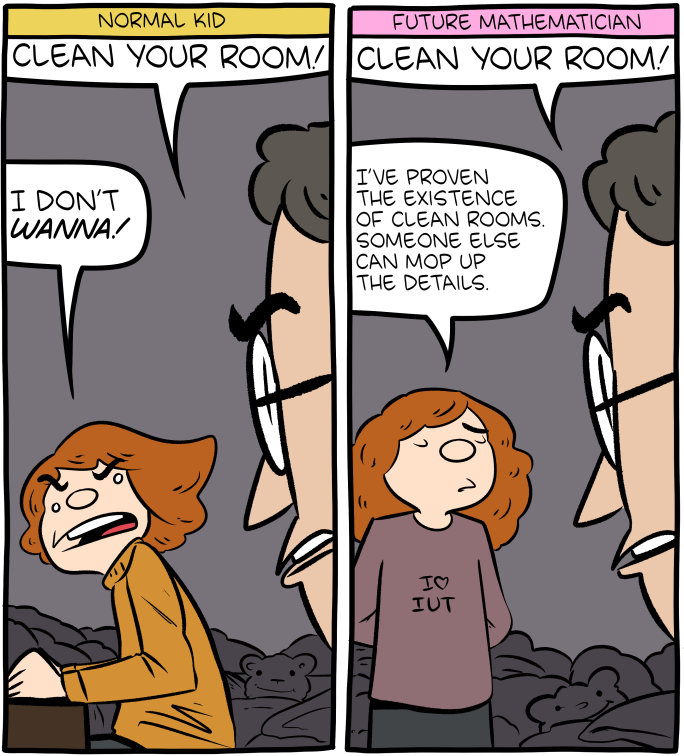
The comic shows two panels, both depicting a parent telling a child to "Clean your room!" In the left panel, labeled "Normal Kid," the child responds with the typical "I don't wanna!" In the right panel, labeled "Kid of Mathematician" (or similar), the child responds: "I've proven the existence and uniqueness of someone else cleaning it. I can work out the details later." Below, the child is labeled with "Jr. IUT."
The child is invoking a mathematical dodge: rather than actually cleaning the room, they claim to have proven that a solution (someone else doing the cleaning) exists and is unique -- they just have not worked out the constructive details of who that person is or how it will happen. This mirrors a common critique in mathematics where existence proofs are considered less useful than constructive proofs.
The Humor
The joke is a parody of Shinichi Mochizuki's Inter-Universal Teichmüller Theory (IUT), a highly controversial set of papers claiming to prove the ABC conjecture. A major criticism of IUT is that key steps in the proof are opaque and difficult to verify -- critics have argued that certain crucial details are hand-waved or that the proof claims results exist without making them explicit enough for verification. The child's excuse perfectly mirrors this controversy: claiming a result exists without providing a clear, constructive path to it.
References
IUT (Inter-Universal Teichmüller Theory) was developed by Shinichi Mochizuki and first released as a series of preprints in 2012. The theory claims to prove the ABC conjecture, one of the most important open problems in number theory. As of 2020, the mathematical community remained deeply divided over whether the proof is valid, with prominent mathematicians Peter Scholze and Jakob Stix identifying what they considered a fundamental gap in the argument.