john-searle39s-last-words

Explanation
The Joke
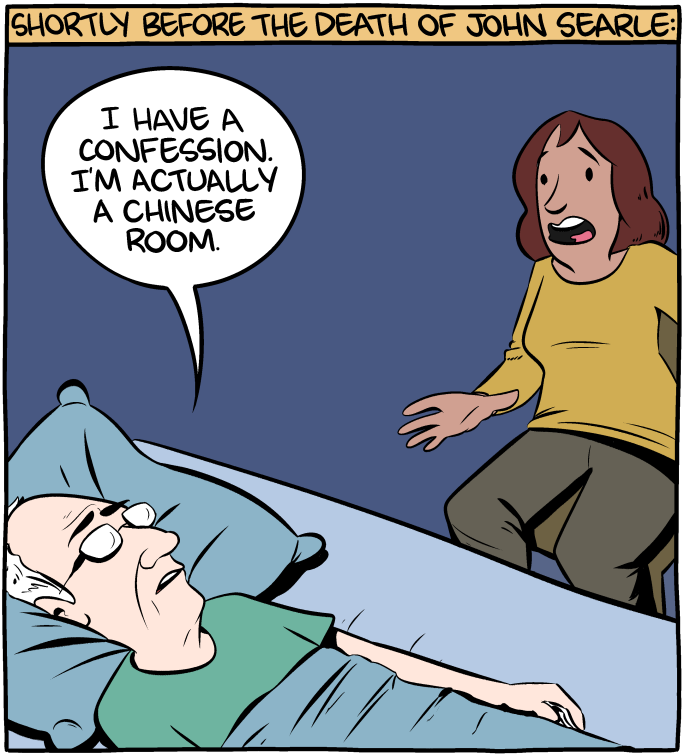
The comic is set "shortly before the death of John Searle." A woman rushes to the bedside of the elderly, dying philosopher and blurts out a confession: "I have a confession. I am actually a Chinese Room."
This is a deeply nerdy philosophy joke. John Searle is the philosopher who created the famous "Chinese Room" thought experiment, which argues that a computer program can never truly "understand" language or have consciousness -- it merely manipulates symbols according to rules without any real comprehension.
The Humor
The joke works on multiple levels. First, there is the absurdity of a person confessing on someone's deathbed that they are actually a philosophical thought experiment rather than a real person. Second, it is the ultimate ironic twist for Searle specifically: his entire career was built on arguing that something could appear to understand and communicate without actually having any real understanding. Having his companion reveal that she was a Chinese Room all along would mean his own life was a demonstration of his own argument -- he was fooled by something that appeared conscious but (by his own definition) was not. It is both a validation and a cruel joke at the expense of his life's work.
References
The Chinese Room argument was proposed by philosopher John Searle in his 1980 paper "Minds, Brains, and Programs." The thought experiment imagines a person in a sealed room who receives Chinese characters, follows a set of English instructions to manipulate them, and produces Chinese output -- without ever understanding Chinese. Searle argued this showed that a computer running a program cannot have a "mind" or "understanding" even if it passes the Turing test. It remains one of the most debated arguments in the philosophy of artificial intelligence. John Searle (born 1932) is an American philosopher at UC Berkeley.