jurassic

Explanation
The Joke
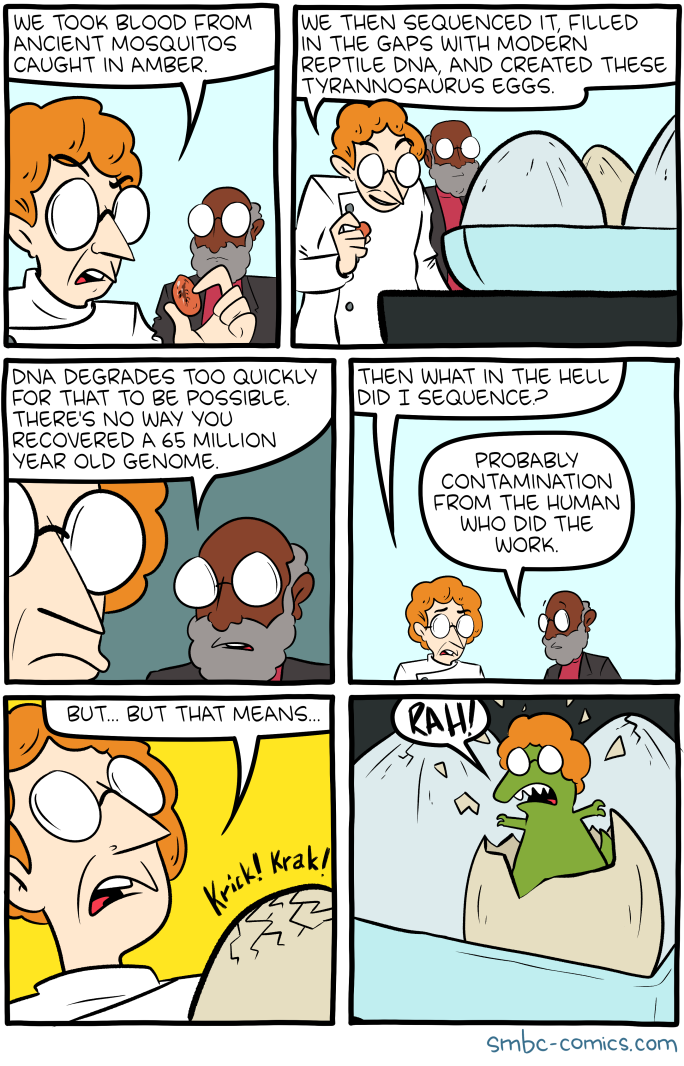
The comic parodies the premise of Jurassic Park. A scientist explains that they took blood from ancient mosquitoes caught in amber, then sequenced it, filled in gaps with reptile DNA, and created "technologically cloned" eggs. A skeptic challenges this, saying the DNA would be too degraded -- there is no way to reconstruct a hundred-million-year-old genome. The scientist, instead of defending the science, deflects: "Then what in the hell is gestating in the secondary compound?" The skeptic responds with more questions about probability and contamination: "Who did the work?" But the final panel reveals a dinosaur-like creature hatching and growling, with the scientist and skeptic fleeing in terror.
The joke is that the movie Jurassic Park (and real-world critics) correctly points out that the science of cloning dinosaurs from ancient amber-preserved DNA is basically impossible. But the comic takes the position that if you somehow did get a viable creature out of such a flawed process, the result would be even more terrifying -- because you have no idea what you actually made. The thing hatching is not a dinosaur reconstructed from a known genome; it is some unknown horror assembled from degraded fragments and gap-filling guesswork.
The Humor
The humor comes from the collision of scientific skepticism with practical consequences. The skeptic is absolutely right that the science does not work, but being right becomes irrelevant when a monster is hatching in front of you. The comic cleverly inverts the usual Jurassic Park narrative: instead of "we made dinosaurs and lost control," it is "we definitely did not make dinosaurs, so what the hell is that thing?" -- which is arguably much scarier. The final panel of both characters screaming sells the punchline perfectly.
References
This comic references the 1993 film Jurassic Park (based on Michael Crichton's 1990 novel), in which scientists clone dinosaurs from DNA preserved in mosquitoes trapped in amber. The real-world scientific consensus is that DNA degrades far too quickly for this to be possible -- studies suggest DNA has a half-life of approximately 521 years, making million-year-old genome recovery effectively impossible.