k
Explanation
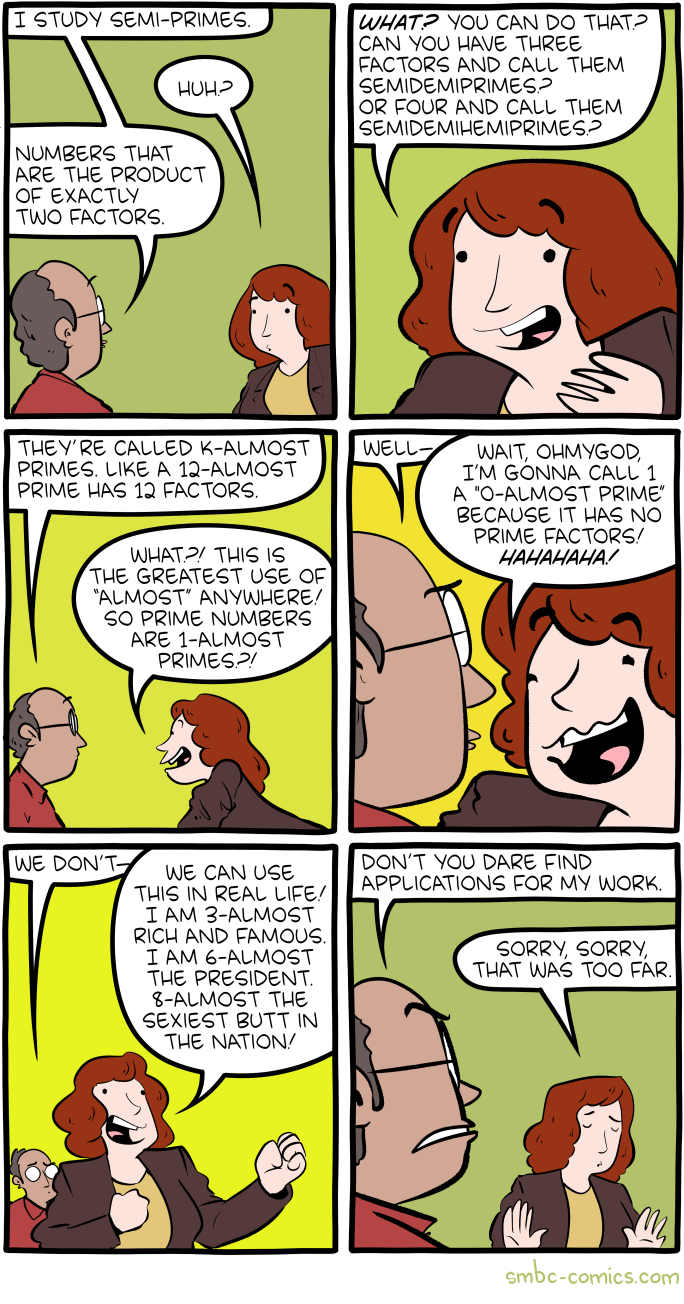
In this comic, a character enthusiastically explains their work: "I study semi-primes!" When asked what those are, they explain: "Numbers that are the product of exactly two primes." They then get excited: "You can do this? So you can take two primes, and call them grandparent-primes, and then multiply those to get grandparent-semi-primes, and then use those as factors to get great-grandparent-semi-prime-primes?"
The mathematician grows increasingly animated, declaring that these are called "almost-primes" -- "like a 12-almost-prime, like 2 to the 12th!" Another character exclaims: "That's the greatest use of 'almost' anywhere. All numbers made of primes are almost primes!" The mathematician responds: "No! I use 'almost' in a very precise way. I am 3-almost certain of this. The President is 5-almost behind me on this."
When challenged -- "Don't you dare trivialize my work!" -- the other person says: "Sorry. Sorry. That was too far."
The joke plays with the real mathematical concept of "semi-primes" (numbers that are the product of exactly two primes, like 15 = 3 x 5) and the related concept of "k-almost primes" (numbers with exactly k prime factors counted with multiplicity). The comic takes these legitimate mathematical terms and extends them to absurd lengths, imagining genealogical hierarchies of number types ("grandparent-semi-primes") and then applying the prefix "almost" to everyday language ("3-almost certain," "5-almost behind me").
The humor lies in the escalating absurdity of mathematical jargon being applied outside its domain. The concept of "almost prime" is already somewhat funny because all composite numbers are, in a sense, "made of primes" -- so calling something "almost prime" feels like an understatement. The comic exaggerates this by having characters use the k-almost prefix in conversation, which is both a legitimate parody of how mathematicians name things and a joke about how specialized terminology can sound absurd to outsiders. The social dynamics are also funny: the mathematician takes genuine offense at their field being mocked, and the other person has to apologize -- a relatable dynamic in any academic field where outsiders find the jargon inherently comical.