knock-knock

Explanation
The Joke
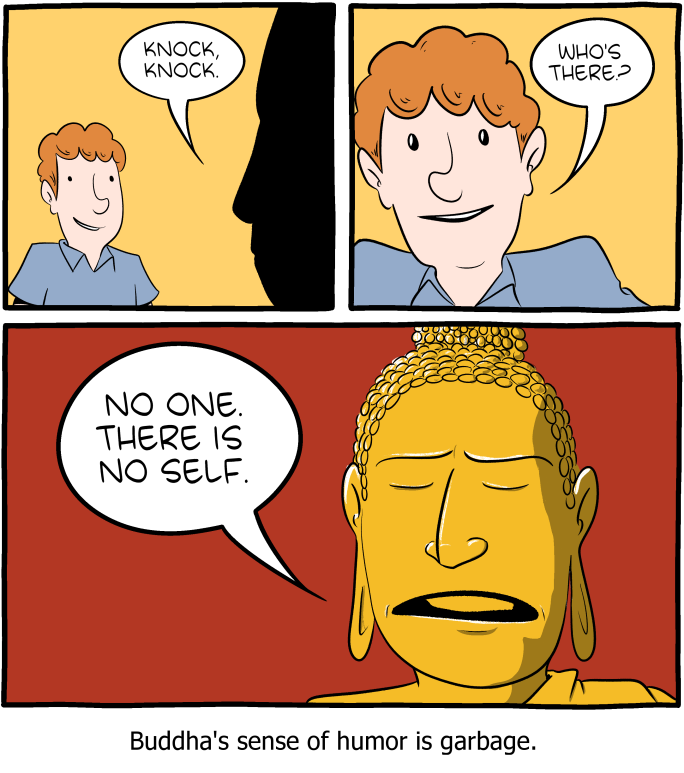
A man begins telling a knock-knock joke to another person. When the second person responds with the expected "Who's there?", the first person is suddenly replaced by a serene golden Buddha who answers: "No one. There is no self." The caption reads "Buddha's sense of humor is garbage."
The joke plays on the Buddhist concept of anatta (or anatman), the doctrine of "no-self," which holds that there is no permanent, unchanging soul or self. In Buddhism, the sense of a fixed individual identity is considered an illusion. By inserting this philosophical concept into the structure of a knock-knock joke -- a format that fundamentally depends on someone being "there" -- the comic creates an absurd collision between a children's joke format and deep metaphysical philosophy.
The Humor
The humor works because knock-knock jokes are built entirely on the premise of identity: someone is at the door, and the fun comes from finding out who. Buddha's answer demolishes the entire joke structure by denying the existence of a "who" in the first place. The caption's blunt editorial judgment -- "Buddha's sense of humor is garbage" -- adds a second layer of comedy by treating one of history's most revered spiritual teachers as simply a bad comedian who ruins parties with philosophy.
References
The concept of anatta (Pali) or anatman (Sanskrit) is one of the three marks of existence in Buddhist philosophy, alongside impermanence (anicca) and suffering (dukkha). It asserts that what we think of as a "self" is actually a constantly changing collection of aggregates (skandhas) with no fixed essence.