Lagrangian Wax
Explanation
The Joke
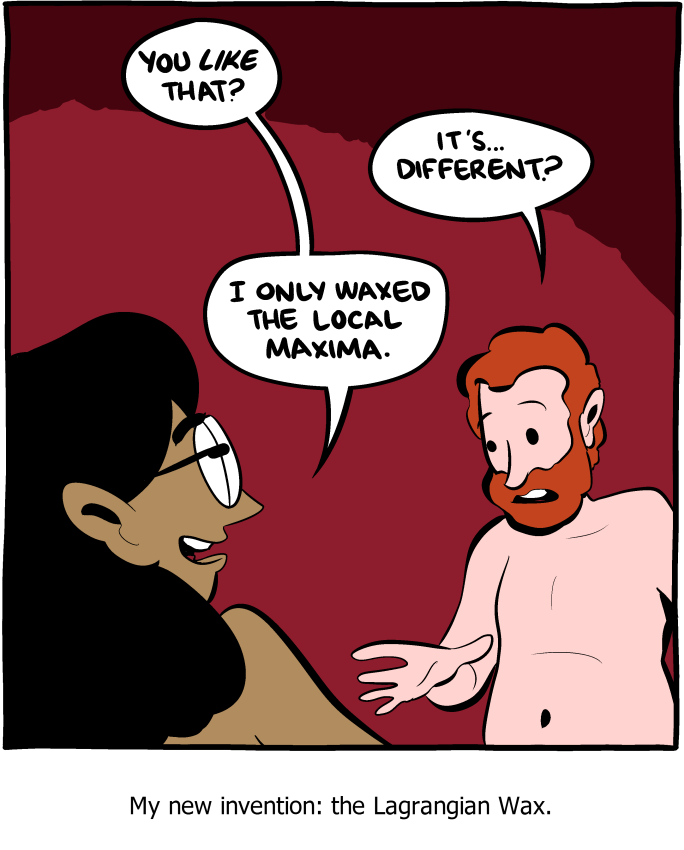
A woman asks a shirtless man "You like that?" referring to something she has done with her body hair. The man responds uncertainly, "It's... different?" She explains: "I only waxed the local maxima." The caption below reads: "My new invention: the Lagrangian Wax."
The joke is that instead of waxing all body hair uniformly, she has selectively waxed only the "local maxima" -- the highest points of hair growth -- leaving everything else. This would result in a bizarre, patchy appearance where only the tallest tufts of hair have been removed.
The Humor
The humor comes from applying mathematical optimization terminology to the mundane act of body waxing. In calculus and mathematical optimization, "local maxima" are the points where a function reaches its highest value in a local neighborhood. The "Lagrangian" in the title refers to the Lagrangian function, a key concept in optimization theory (named after Joseph-Louis Lagrange), which is used to find the maxima and minima of functions subject to constraints.
The absurdity lies in treating body hair as a mathematical function and applying optimization techniques to grooming. Instead of the practical goal of smooth skin, the woman has approached waxing as a mathematical problem, removing only the peak points. The man's bewildered response ("It's... different?") perfectly captures the reaction someone would have to this nonsensical approach to personal grooming.
References
- Lagrangian: Named after mathematician Joseph-Louis Lagrange (1736-1813), the Lagrangian function is central to classical mechanics and optimization theory. Lagrange multipliers are used to find local maxima and minima of functions subject to equality constraints.
- Local Maxima: In calculus, a local maximum is a point where a function's value is greater than or equal to the values at all nearby points, but not necessarily the greatest value overall (that would be the global maximum).