laplace39s-demon

Explanation
The Joke
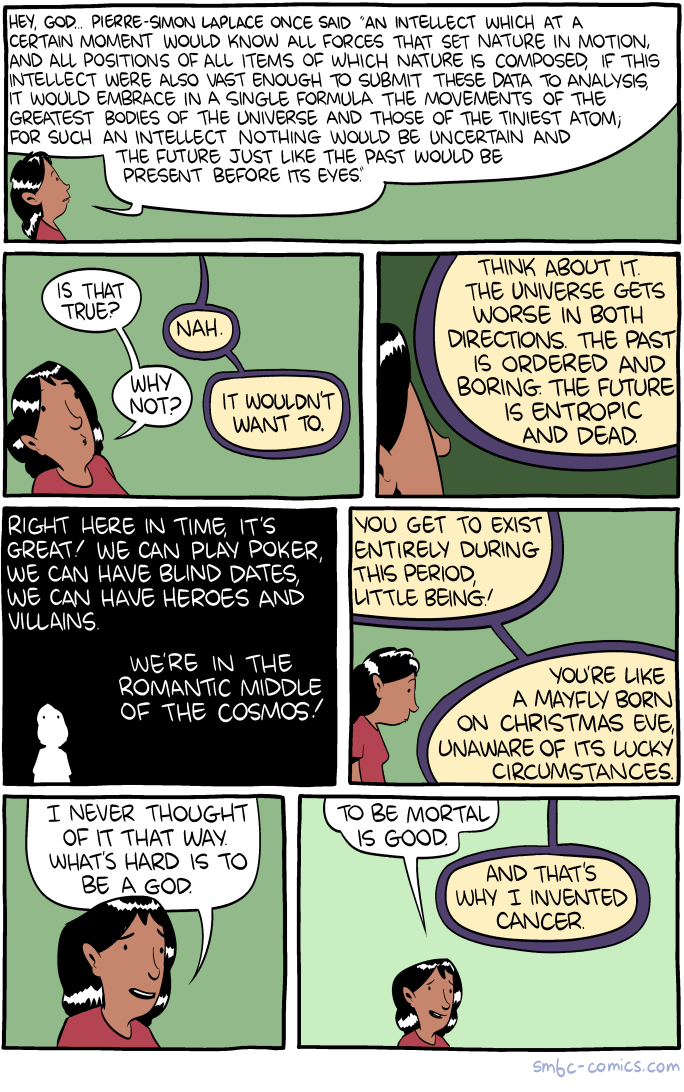
A woman quotes Pierre-Simon Laplace to God, referencing his famous thought experiment about an intellect that could know all forces and positions in the universe and thereby predict the entire future -- commonly known as "Laplace's Demon." She asks God if this is true. God says "Nah." When she asks why not, God replies, "It wouldn't want to."
God then explains: the universe gets worse in both directions. The past is ordered and boring; the future is entropic and dead. Right here, in the middle of cosmic time, is the sweet spot -- you can play poker, have blind dates, have heroes and villains. God calls this "the romantic middle of the cosmos" and tells the woman she is like a mayfly born on Christmas Eve, unaware of its lucky circumstances. The woman is moved by this reframing and says she never thought of it that way, and that being mortal is actually good. God agrees -- and then cheerfully adds, "And that's why I invented cancer," instantly undercutting the entire uplifting moment.
The Humor
The comic builds a genuinely compelling philosophical argument: that an omniscient being would not want perfect knowledge because the interesting part of the universe is the messy, uncertain middle era we happen to inhabit. It is a surprisingly poetic reframing of mortality and uncertainty as features rather than bugs. The reader is drawn into this beautiful perspective, only to have it demolished by the final punchline about cancer. This is classic SMBC structure -- build up a sincere intellectual argument, then destroy it with a dark joke.
The joke about Laplace's Demon "not wanting to" know everything is also funny because it anthropomorphizes a thought experiment in an unexpected way. The original concept is about whether perfect prediction is theoretically possible; God sidesteps the physics entirely and makes it a question of preference.
References
Laplace's Demon is a famous thought experiment proposed by Pierre-Simon Laplace in 1814, in his "A Philosophical Essay on Probabilities." It posits a hypothetical intellect that knows the precise position and momentum of every particle in the universe and could therefore calculate the entire past and future. The concept is central to debates about determinism and was later challenged by quantum mechanics (Heisenberg's uncertainty principle) and chaos theory.
The comic also references the concept of heat death -- the thermodynamic prediction that the universe will eventually reach maximum entropy, a state of no usable energy and no structure, effectively "dying" -- which is what God means by the future being "entropic and dead."