Law
Explanation
The Joke
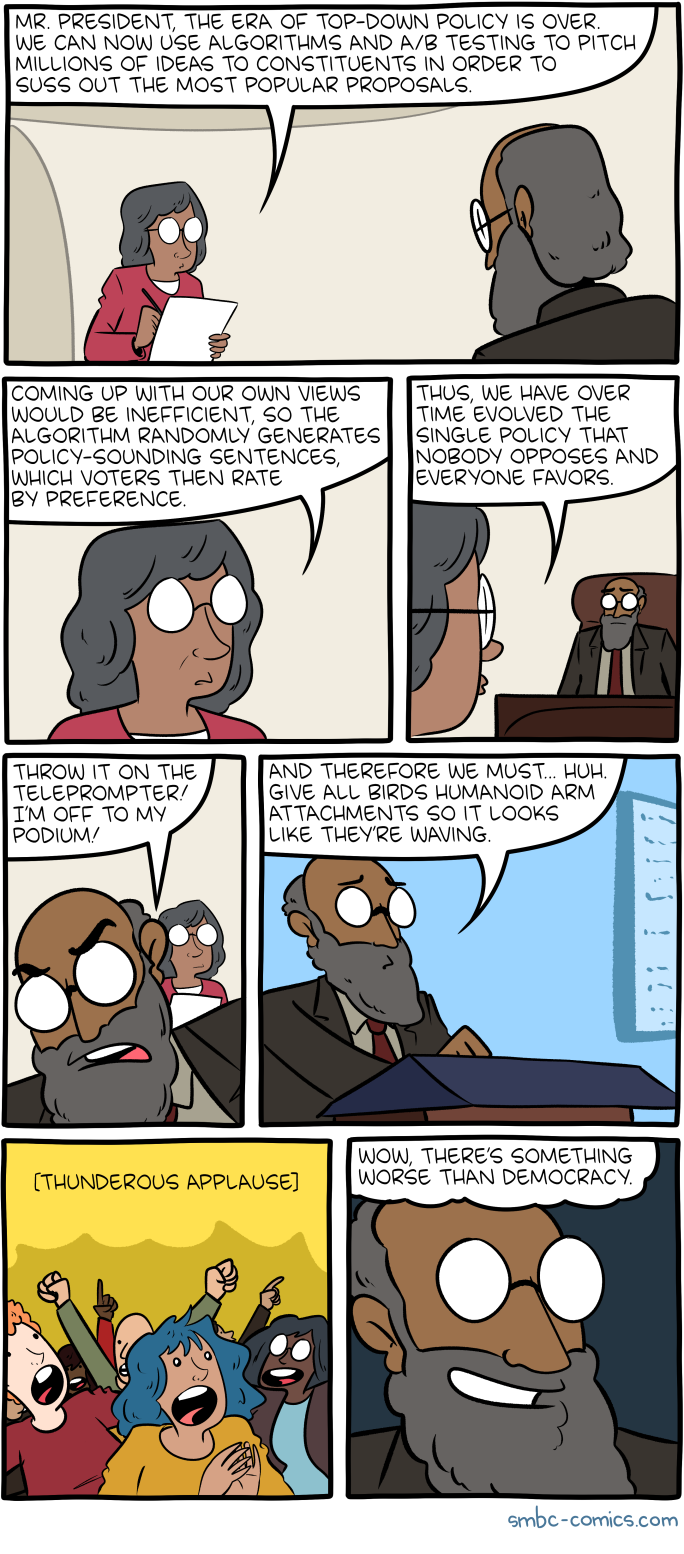
A politician addresses the public, declaring that the era of top-down policy is over. Instead, they propose using big data, algorithms, and A/B testing to poll all citizens in order to identify the most popular proposals. At first, this sounds like a progressive, democratic innovation. But then the politician explains further: someone pointed out that simply doing what data says would make the executive branch redundant, so they built in "random corruption and nepotism" to the algorithmic policy-making. The crowd erupts in thunderous applause, and someone in the audience remarks, "Now THERE'S something more than democracy."
The comic satirizes the cynical view that corruption and nepotism are not bugs in government but features that people have come to expect and even embrace. The joke is that when given a perfectly efficient, data-driven system, they had to deliberately re-introduce the dysfunction of traditional governance to make people comfortable with it.
The Humor
The humor works through a bait-and-switch structure. The setup presents what seems like a utopian technocratic proposal -- using algorithms and big data to create optimal policy. The punchline reveals that the system was intentionally sabotaged with corruption to preserve the role of politicians, and the crowd loves it even more. The final panel's remark that this is "something more than democracy" delivers the darkest layer of irony: the audience genuinely prefers a corrupt system to a functional one, as long as it preserves familiar power structures.
The comic also pokes fun at the tech-solutionist mindset -- the idea that big data and algorithms can solve political problems -- by showing that even if the technology worked perfectly, human institutions would find a way to corrupt it.
References
The comic references the growing discourse around algorithmic governance and the use of big data in public policy. It also touches on the concept of "technocracy" -- governance by technical experts -- and the tension between efficient governance and democratic representation. The deliberate insertion of "random corruption" parodies how real institutions often preserve inefficiencies to protect entrenched interests.