lean
Explanation
The Joke
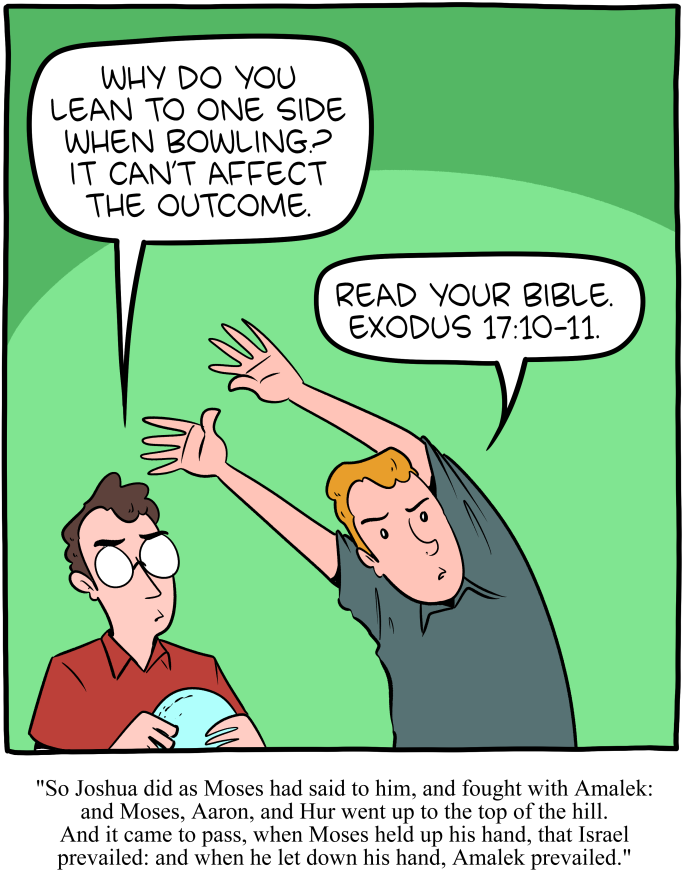
Two men are bowling. One asks, "Why do you lean to one side when bowling? It can't affect the outcome." The other responds: "Read your Bible. Exodus 17:10-11." The comic then shows the referenced Bible passage, which describes the battle of the Israelites against the Amalekites. In this passage, as long as Moses held his hands up, Israel was winning, but whenever he lowered his hands, Amalek prevailed. Aaron and Hur had to physically hold Moses' arms up to ensure victory.
The joke draws a parallel between the superstitious lean of a bowler (believing body English can steer the ball after it's been released) and Moses' arm-raising during battle. Both involve a person making physical gestures that shouldn't have any causal effect on the outcome but are believed to be essential. The bowler is citing biblical precedent for the idea that sympathetic body movements can magically influence distant events.
The Humor
The humor works on multiple levels. First, there's the absurdity of citing a specific Bible verse to justify leaning while bowling — treating Scripture as a manual for sports superstition. Second, the passage actually does support the bowler's logic surprisingly well: Moses' arm position had no physical mechanism to influence a battle happening elsewhere, yet it apparently worked. The comic slyly suggests that if you accept biblical miracles, you have to at least consider that leaning during bowling might work too. It also gently mocks both bowling superstition and biblical literalism by equating the two, implying that both rely on the same kind of magical thinking.
References
- Exodus 17:10-11: The biblical account of the battle at Rephidim, where the Israelites fought the Amalekites. Moses' raised arms served as a conduit for divine intervention, and when his arms tired, Aaron and Hur supported them.
- Body English: The common practice of contorting one's body after releasing a ball (in bowling, pool, golf, etc.) as if the physical movement could steer the ball's trajectory. It is a well-known form of superstitious behavior in sports.