Library

Explanation
The Joke
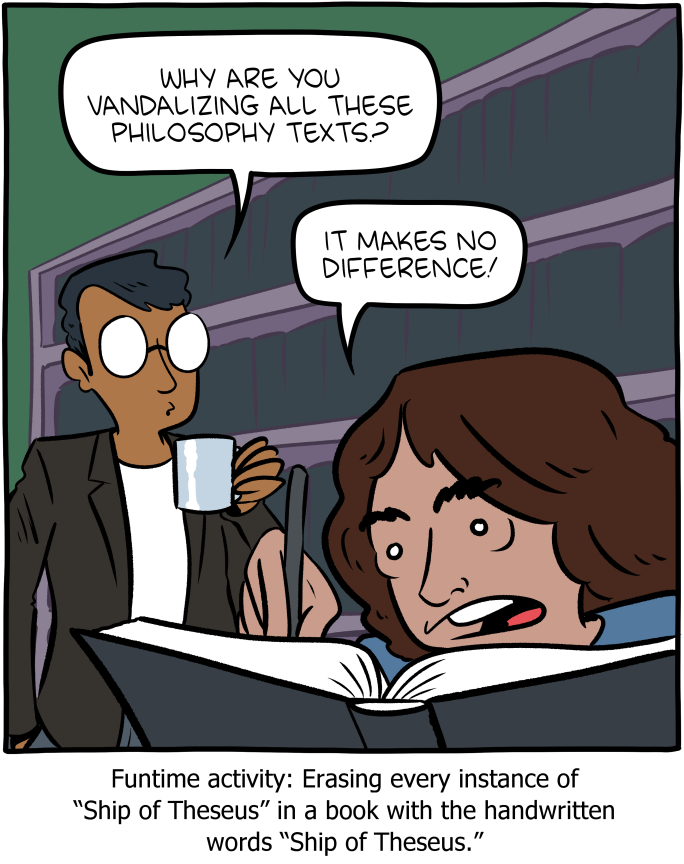
The comic shows one person confronting another in what appears to be a library, asking: "Why are you vandalizing all these philosophy texts?" The vandal, who is shown writing in a book, calmly replies: "It makes no difference."
The caption below provides the punchline as a "funtime activity": erasing every instance of "Ship of Theseus" in a book with the handwritten words "Ship of Theseus." In other words, the vandal is replacing the printed text with hand-written text that says exactly the same thing.
The joke is a meta-application of the Ship of Theseus paradox. If you replace every printed word in a text with a handwritten version of the same word, is it still the same text? The vandal's answer -- "it makes no difference" -- is itself a philosophical position on the paradox: that replacing components with identical substitutes does not change the essential nature of the thing.
The Humor
The humor operates on a beautifully recursive level. The Ship of Theseus is a classic philosophical thought experiment asking whether an object that has had all of its components replaced remains fundamentally the same object. By physically replacing the printed words "Ship of Theseus" with handwritten versions of "Ship of Theseus," the vandal is literally performing the Ship of Theseus paradox on the very text that describes it.
The comedy is amplified by the context -- this is being done in a library to philosophy texts, making it an act of philosophical vandalism that is itself a philosophical argument. The vandal's casual dismissal ("it makes no difference") is both an answer to the accusation of vandalism and a philosophical stance: if the content is the same, then replacing the physical medium should not matter. The joke rewards readers who are familiar with the paradox, as the full depth of the humor only becomes apparent when you realize the self-referential loop at play.
References
- The Ship of Theseus is an ancient philosophical paradox, traditionally attributed to Plutarch, asking whether a ship that has had every plank replaced is still the same ship.
- The paradox has been widely discussed by philosophers including Thomas Hobbes, John Locke, and in modern times has appeared in popular culture (including the TV show WandaVision).
- The paradox is closely related to questions of personal identity, continuity, and the nature of objects over time.