limitless
Explanation
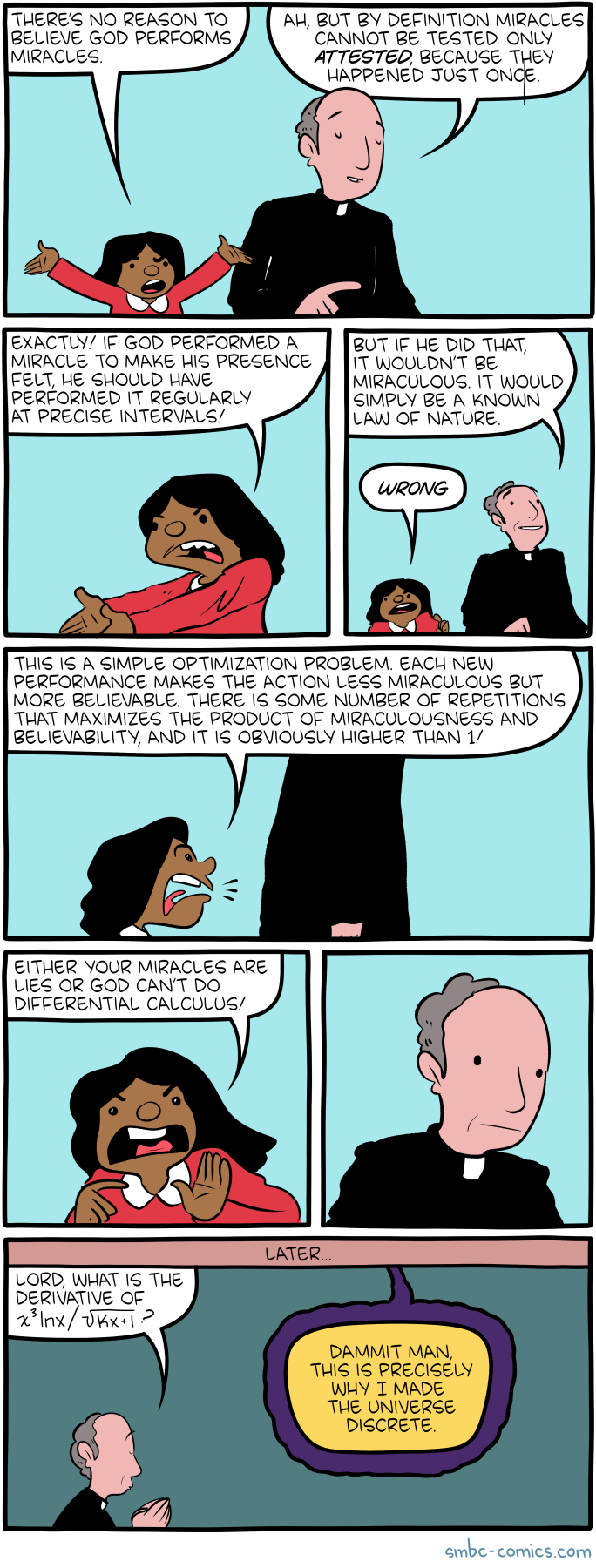
This comic explores a theological argument about miracles and God's existence through a debate between a theologian (or believer) and a skeptic (likely a priest or clergyman based on his collar).
In the first panel, the woman argues: "There's no reason to believe God performs miracles." The priest counters that by definition, miracles cannot be tested or anticipated because they are "attested because they happened just once."
In the second panel, the woman pushes back: "Exactly! If God performed a miracle to make his presence known, it wouldn't be irrational -- it would simply be a known, repeatable fact of reality." She is arguing that a genuinely all-powerful God could easily provide consistent, verifiable evidence of his existence rather than relying on one-off, untestable events. The priest exclaims "Wrong!"
In the third panel, the woman delivers the key logical argument: "There is an optimization problem. Each new miracle that God performs makes him slightly more believable. There is some number of repetitions after which the expected benefit of one more miracle exceeds the cost to believability, and it is obviously higher than 1!" In other words, she applies mathematical optimization to the question of how many miracles God should perform -- if miracles help people believe, doing just one is clearly suboptimal.
She concludes: "Either your miracles are lies, or God can't do differential calculus." This is a humorous false dilemma: either miracles don't happen, or God is bad at math.
The final panel, set "later," shows the priest on the phone saying "Lord, what is the derivative of sin?" -- a math pun, since "sin" is both a trigonometric function (whose derivative is cosine) and a theological concept. God replies: "Dammit man, that's a polynomial, but I made myself too discrete" -- another layered math pun. "Discrete" refers to discrete mathematics (as opposed to continuous calculus), but also suggests God has made himself too hidden or separate from the world to answer such questions. The word "polynomial" is also humorously wrong (sin is not a polynomial), adding to the joke that God is indeed bad at calculus.
The comic satirizes theological arguments about miracles by applying rational optimization theory, and the punchline doubles down with mathematical wordplay.