limits

Explanation
The Joke
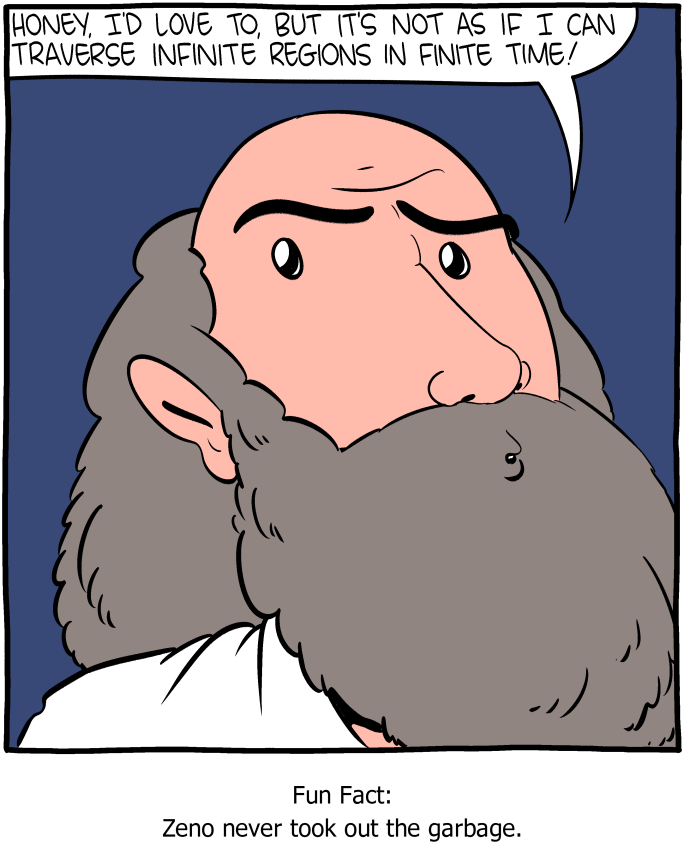
The comic depicts Zeno of Elea, the ancient Greek philosopher famous for his paradoxes about motion, using his own philosophical arguments as an excuse to avoid doing household chores. He says to his wife (off-panel), "Honey, I'd love to, but it's not as if I can traverse infinite regions in finite time!" This is a direct reference to Zeno's most famous paradox, the Dichotomy Paradox, which argues that in order to travel any distance, you must first travel half that distance, then half the remaining distance, and so on infinitely -- therefore motion should be impossible because you'd need to complete an infinite number of steps.
The caption below reads: "Fun Fact: Zeno never took out the garbage." This extends the joke by implying that Zeno habitually deployed his own paradoxes to get out of mundane domestic tasks, treating a profound philosophical puzzle about the nature of infinity and motion as nothing more than a convenient excuse for laziness.
The Humor
The comedy comes from the absurd collision of high philosophy and low domesticity. Zeno's paradoxes were serious intellectual challenges that occupied mathematicians for over two millennia until the development of calculus and the formal theory of convergent infinite series provided rigorous solutions. Reducing this grand philosophical tradition to a husband dodging chores is a classic SMBC move -- deflating intellectual pretension by grounding it in the most mundane reality possible. The "Fun Fact" caption style adds a mock-educational tone that makes the punchline land even harder.
References
- Zeno's Dichotomy Paradox: One of several paradoxes attributed to Zeno of Elea (c. 490-430 BCE). The paradox argues that motion is impossible because any finite distance contains an infinite number of half-distances to be traversed. Modern mathematics resolves this by showing that an infinite series can converge to a finite sum (e.g., 1/2 + 1/4 + 1/8 + ... = 1).
- The alt text notes "The meta-joke here is that he's mostly not helping because ancient Greek society was extremely misogynistic," adding another layer: the real historical reason Zeno wouldn't do housework had nothing to do with paradoxes and everything to do with gender roles in ancient Greece.