literature

Explanation
The Joke
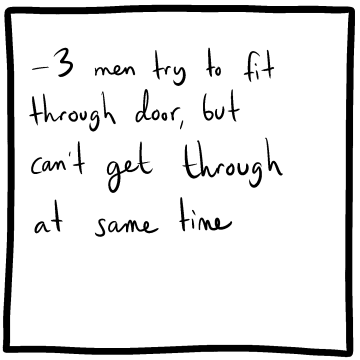
The comic shows a handwritten notebook page with a list of story ideas, all following the same pattern:
- "Old man wants to take oversized piece of luggage on plane, but airline says no"
- "Old man tries to get pickle out of jar, but pickle too long"
- "Old man tries to eat entire pie, but not hungry enough"
- "Old man tries to fit whole fish in boat, but fish too big"
Below the list are some doodles of fish. The caption reads: "Not all of Hemingway's notebooks have been made public."
The Humor
The joke is that all of these mundane story ideas are reductive parodies of Ernest Hemingway's famous novella "The Old Man and the Sea," in which an aging fisherman struggles to land a giant marlin that is too large for his small boat. Each "idea" follows the same basic template -- an old man attempts something involving an object that is too large or a task beyond his capacity -- reducing Hemingway's acclaimed literary work to its most absurdly simplified structural formula. The implication is that Hemingway was a one-trick pony who just kept reworking the same "old man vs. something too big" concept, and that "The Old Man and the Sea" was simply the version of this formula that happened to work. The fish doodles at the bottom reinforce the connection to his famous novella.
References
Ernest Hemingway (1899-1961) was one of the most influential American novelists of the 20th century. "The Old Man and the Sea" (1952) tells the story of Santiago, an aging Cuban fisherman who hooks an enormous marlin in the Gulf Stream. The fish is so large that he cannot haul it into his skiff. The novella won the Pulitzer Prize for Fiction in 1953 and was cited when Hemingway received the Nobel Prize in Literature in 1954. Hemingway was known for his terse, minimalist prose style, which the notebook's simple phrasing also parodies.