lobby
Explanation
The Joke
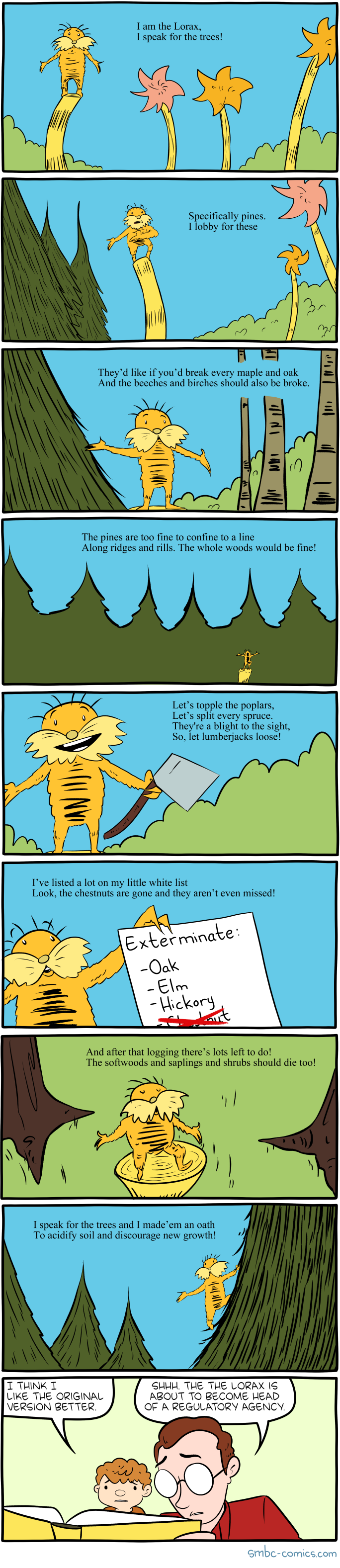
The comic is narrated by a character called "The Lorax" (visually resembling Dr. Seuss's Lorax character -- a small, mustachioed creature who "speaks for the trees"). The Lorax traditionally advocates for environmental protection. In this SMBC version, the Lorax begins in the usual way, speaking on behalf of the trees, but things take a dark turn.
The Lorax describes how the trees formed a political entity, and that he began to lobby on their behalf. The trees' political platform escalates from reasonable environmental advocacy to increasingly extreme and sinister demands. The story ends with the Lorax becoming a corrupt political operative, and the trees' agenda becoming something far more menacing than simple conservation -- culminating in a manifesto-like document with aggressive demands like "Exterminate," "Oak," "Elm," and "Hickory."
A child reading the story with a parent is disturbed, and the parent shares the child's concern, suggesting that "The Lorax and I maybe not read this one again."
The Humor
The comic subverts the wholesome environmentalism of Dr. Seuss's "The Lorax" by imagining what would actually happen if trees had political representation. Instead of a heartwarming tale of environmental stewardship, giving trees political agency leads to the same corrupting dynamics of lobbying, extremism, and political violence that characterize human politics. The joke works because it applies cynical real-world political realism to a children's story premise, revealing that "speaking for the trees" could be just as dark as any other form of political advocacy.
References
"The Lorax" is a 1971 children's book by Dr. Seuss about a creature who "speaks for the trees" against industrial destruction of the environment. It is one of the most famous environmental allegories in children's literature.