longitude

Explanation
The Joke
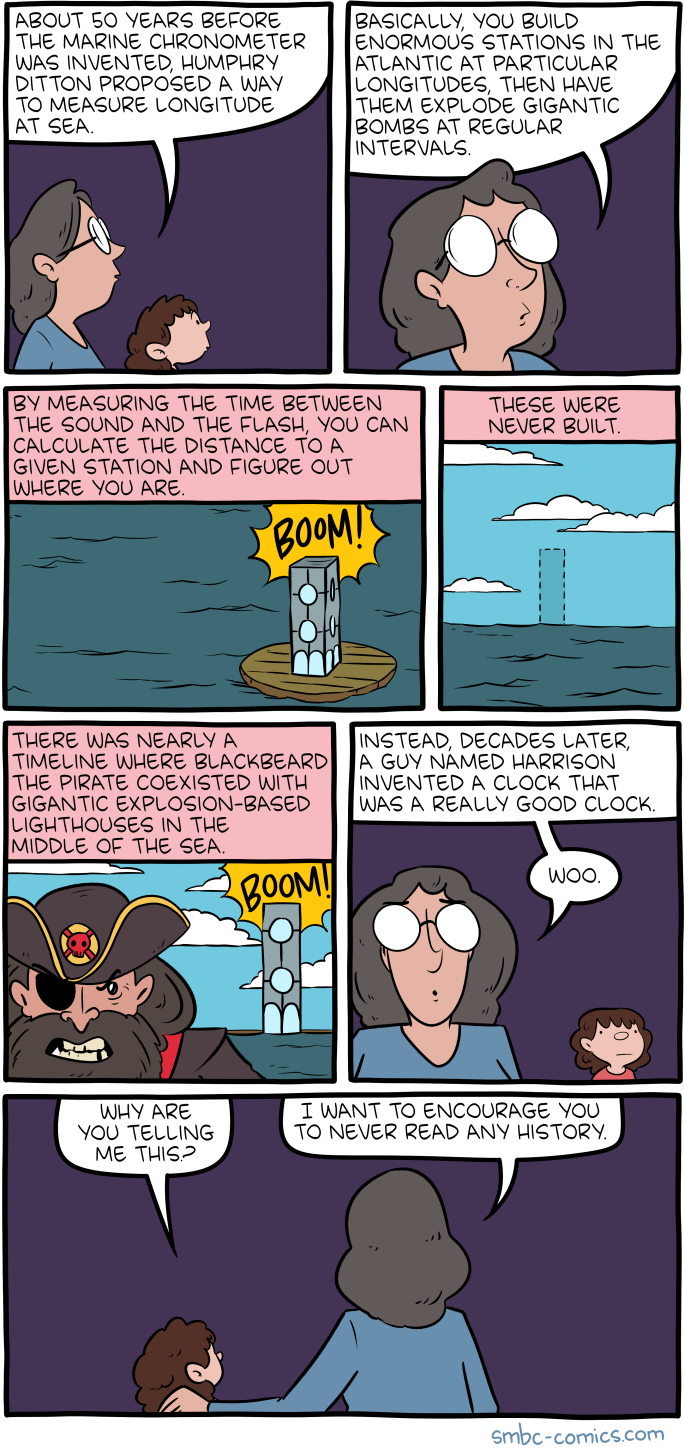
The comic presents a mini history lesson about the longitude problem. A narrator explains that about 50 years before the marine chronometer was invented, sailors had no reliable way to determine their longitude at sea. A system was proposed: build loud explosion stations along known longitudes, then have them fire bombs at regular intervals. By measuring the time between seeing the flash and hearing the sound, a ship could calculate its distance from a given station and figure out where it was. The comic notes these were never built.
Instead, decades later, a craftsman named Harrison simply built a really good clock -- the marine chronometer -- which solved the problem elegantly without any explosions. The punchline comes when a student asks "Are you telling me to never read any history?" and the teacher responds "I want to encourage you to never read any history," implying that learning about history reveals how absurdly overcomplicated humans made things before arriving at simple solutions.
The Humor
The humor lies in the contrast between the ludicrously elaborate "explosion station" scheme and the elegant simplicity of Harrison's chronometer. The proposed solution -- a network of strategically placed bomb towers constantly detonating across the ocean -- is so gloriously over-engineered that it makes the eventual solution (just build a good clock) seem almost anticlimactically obvious. The teacher's final encouragement to "never read any history" is funny because it inverts the usual educational message; instead of "those who don't know history are doomed to repeat it," the comic suggests that knowing history just makes you despair at how unnecessarily complicated humans make everything.
References
The comic references the real historical longitude problem, one of the great scientific challenges of the 18th century. The British Parliament passed the Longitude Act of 1714, offering a prize for a practical method of determining longitude at sea. The explosion-station concept described in the comic is based on real proposals that were considered. John Harrison, an English carpenter and clockmaker, eventually solved the problem by building the H4 marine chronometer in 1761, a timepiece accurate enough to keep time at sea and thereby allow navigators to calculate longitude by comparing local noon with the time at a known reference meridian (Greenwich).