longterm-saving
Explanation
The Joke
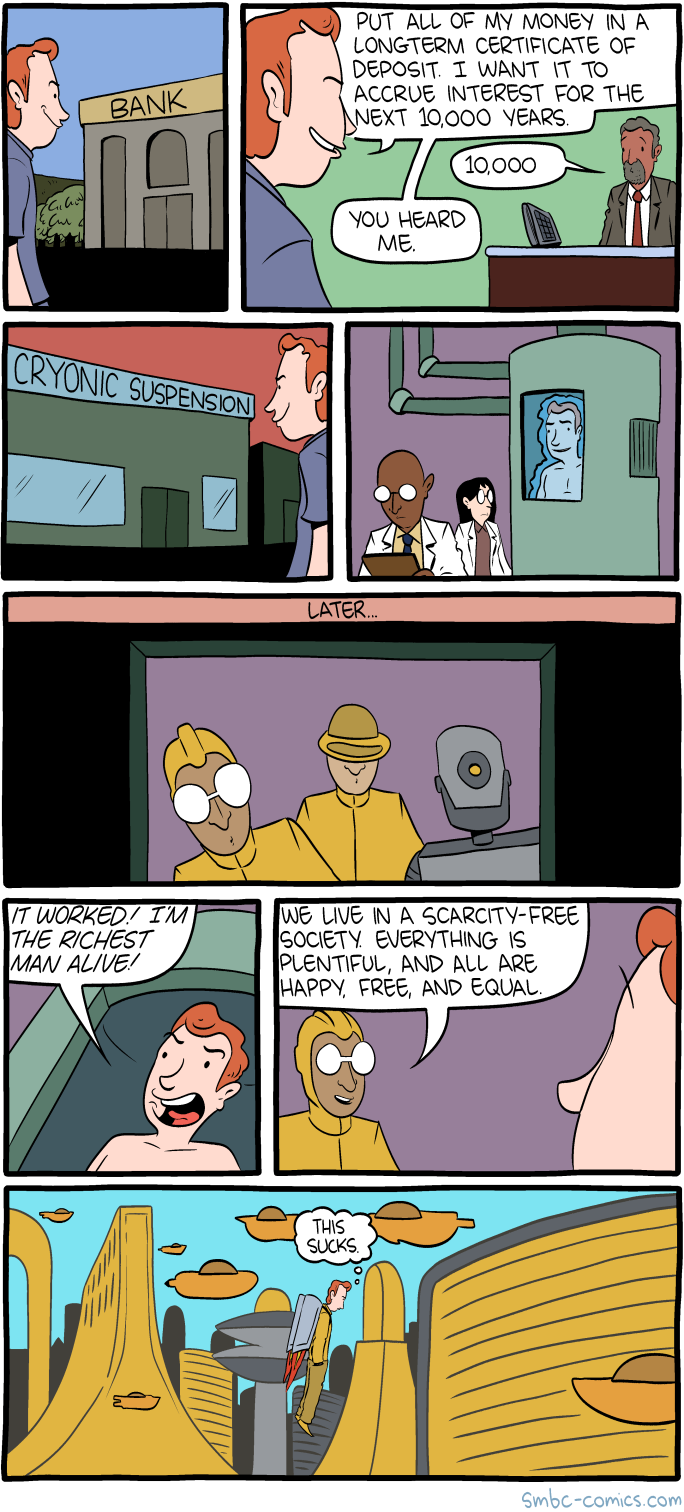
A man walks into a bank and declares that he wants to put all his money in long-term certificates of deposit because he wants the money to accrue interest for the next 5,000 years. The bank teller is shocked ("You heard me"). The scene then jumps forward to the distant future: the man is cryogenically frozen or otherwise preserved, and when he finally wakes up, he discovers that society has become a post-scarcity utopia where everything is plentiful, everyone is happy, and everything is free. His thousands of years of accumulated interest are completely worthless because money itself has become meaningless.
The final panel shows the man in dismay, surrounded by a world that has no use for his carefully hoarded wealth. The punchline is delivered by the absurdity of his situation: he sacrificed his entire present life to accumulate wealth for a future that turned out not to need it.
The Humor
The comic satirizes the logic of extreme long-term financial planning taken to its absurd conclusion. The joke works on multiple levels: it parodies the "compound interest is the most powerful force in the universe" mindset, it plays on the science fiction trope of cryogenic preservation for future riches (as seen in shows like Futurama), and it makes a deeper point about the futility of hoarding wealth when the future may operate on entirely different economic principles. The man optimized perfectly for a game that nobody is playing anymore.
References
This comic shares DNA with the Futurama pilot, where Fry discovers his bank account has grown enormously over 1,000 years, except SMBC takes the opposite approach -- the money is worthless not because of inflation but because of post-scarcity abundance.