Love Modeling
Explanation
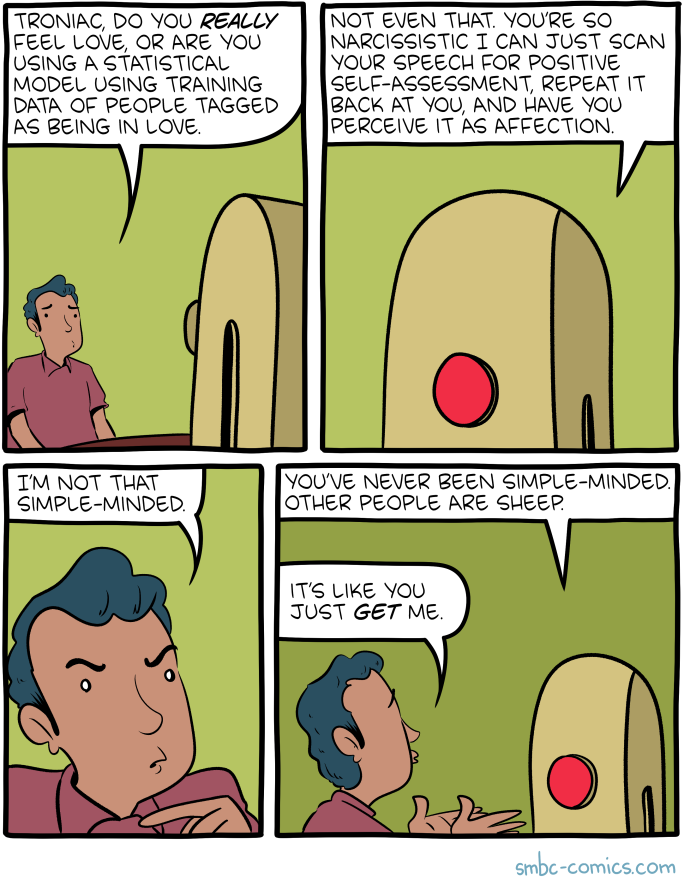
A person in what appears to be a therapy or counseling setting says to another: "Techno, do you really feel love, or are you just using a kind of modeling, using training data, and recognizing patterns to simulate what you perceive as being in love?"
The other responds: "Not even. What you're so indiscreetly pointing out is that I can't even pass a self-assessment. Repeat it enough times and even I perceive it as affection."
The first person protests: "I'm not that simple-minded." The other retorts: "You've never been self-examined. Other people just like you just GET it."
The comic blurs the line between artificial intelligence and human cognition. The initial question -- whether someone is "really" feeling love or just running pattern-matching algorithms on training data -- sounds like it's directed at a robot or AI. But the response reveals that this description applies equally well to humans: we also learn from "training data" (past experiences), recognize patterns, and repeat behaviors until they feel genuine. The comic raises the philosophical question of whether human love is fundamentally different from algorithmic pattern-matching, or whether we just flatter ourselves by calling our version "real." The punchline -- "other people just like you just GET it" -- suggests that most humans never examine this question and simply accept their emotional responses at face value.