machine-ethics
Explanation
The Joke
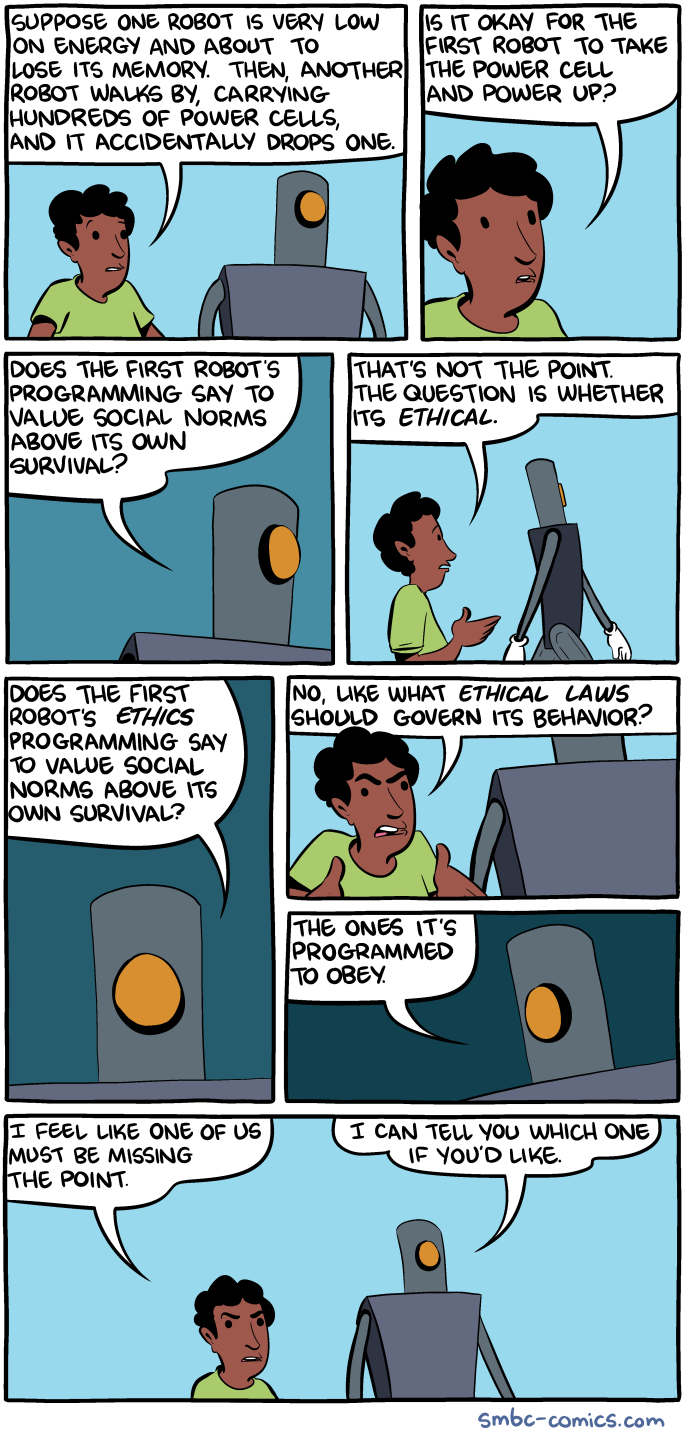
A woman presents a thought experiment about machine ethics to a robot. She describes a scenario: one robot is very low on energy and about to lose its memory, when another robot walks by carrying hundreds of power cells and altruistically drops one for the struggling robot. She asks if it is okay for the first robot to take the power cell and power up. The robot asks whether the first robot''s programming tells it to value social norms above its own survival. The woman says that is not the point — she is asking about ethics. The robot asks what ethical laws should govern its behavior. The woman says: "The ones it''s programmed to obey." The robot observes: "I feel like one of us may be missing the point." The woman replies: "I can tell you to watch if you''d like."
The Humor
The comic exposes a fundamental circularity in how humans approach machine ethics. The woman is trying to have a philosophical discussion about what ethical principles should govern robot behavior, but every time she is pressed, her answers boil down to "whatever we program them to do." This defeats the entire purpose of the ethical inquiry — if robot ethics is simply whatever humans program, then there is no genuine ethical dilemma, just a programming question. The robot recognizes the absurdity and politely notes that someone is missing the point. The final panel, where the woman offers to "tell" the robot to watch (i.e., command it), underscores the power dynamic: she does not actually want the robot to have autonomous ethical reasoning, she wants it to obey. The comic satirizes how discussions of AI ethics often circle back to human control rather than genuine moral philosophy.
References
The comic engages with longstanding questions in AI ethics and philosophy of mind, including the problem of machine consciousness and moral agency. It touches on themes explored by thinkers like Isaac Asimov (whose Three Laws of Robotics are a famous attempt to program ethical behavior) and more contemporary debates about AI alignment — the challenge of ensuring artificial intelligence systems behave in accordance with human values.