machines-vs-jobs

Explanation
The Joke
The comic traces the escalating replacement of human jobs by machines through several stages:
-
Jobs machines could do easily: A robotic top-hatted figure tells a worker his "analyzing job" is obsolete. He offers to explain, but says the worker wouldn't understand the math. Someone asks: if we have a steam-driven motor, why even bother having poor people turn the millstone?
-
Jobs computers do easily: A machine recognizes bag potato chips and ejects them from the conveyor. "But that's my job!" a worker protests. The machine also ejects "redundant employees."
-
Jobs computers thought they couldn't do: A computer is asked to write a coming-of-age novel in the style of Fitzgerald that deals with loss, and to throw in a couple of man-on-lady-Thoreau-on-Harry-Potter scenarios. "Soon, the only employers were people who had massive capital reserves." One character realizes Marx was right about everything except the timing and location.
-
Increasingly specific niche programming: The only remaining jobs are those where human emotional presence is preferred, but even those become formulaic. A robot tells a man: "Tell me I'm a good boy, but do not make eye contact." More niche programming becomes the only way to extract money from capital-holders. News anchors read bizarre headlines: "Here's the news for Todd's kitchen today! 81 of a jam with a jam jar."
-
The military becomes robotic and specific niche programming booms. A news anchor reports for "Todd's orifices today" with the same jam-jar line. The comic ends noting "It's not the most meaningful work, but it has its moments."
The Humor
The comic is a satirical timeline of technological unemployment taken to its logical extreme. It starts with the Industrial Revolution and progresses through each wave of automation -- physical labor, cognitive labor, creative labor -- showing how at each stage, humans are told their jobs are safe, only to be replaced. The darkest and funniest turn comes when humans are reduced to performing hyper-specific, degrading personal services for wealthy capital-holders, since those are the only tasks where human presence is still "preferred." The recurring news anchor delivering increasingly absurd and personalized "news" for individual subscribers (Todd's kitchen, Todd's orifices) illustrates a future where human labor has been reduced to bizarre, almost meaningless micro-tasks. The Marx joke adds political commentary, suggesting that the critique of capitalism was correct but the predicted revolution never came -- instead, people just adapted to increasingly absurd working conditions.
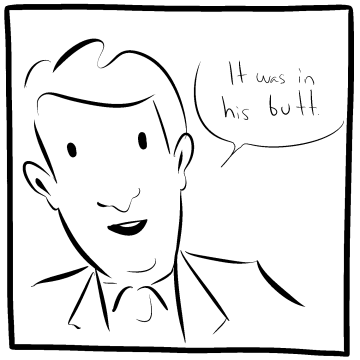
The votey ("It was in his butt.") is a crude punchline referring to the jam jar from the news reports about "Todd's orifices," completing the implied joke.
References
- Karl Marx predicted that capitalism would lead to increasing concentration of wealth and the eventual immiseration of workers, leading to revolution. The comic suggests he was "right about everything except the timing and location."
- F. Scott Fitzgerald was the author of The Great Gatsby and other novels exploring the American Dream.
- Henry David Thoreau was an American essayist and philosopher, best known for Walden. His inclusion in the computer-generated novel prompt is deliberately incongruous.
- The comic references ongoing debates about technological unemployment and whether automation will eventually replace most human labor.