macro-2
Explanation
The Joke
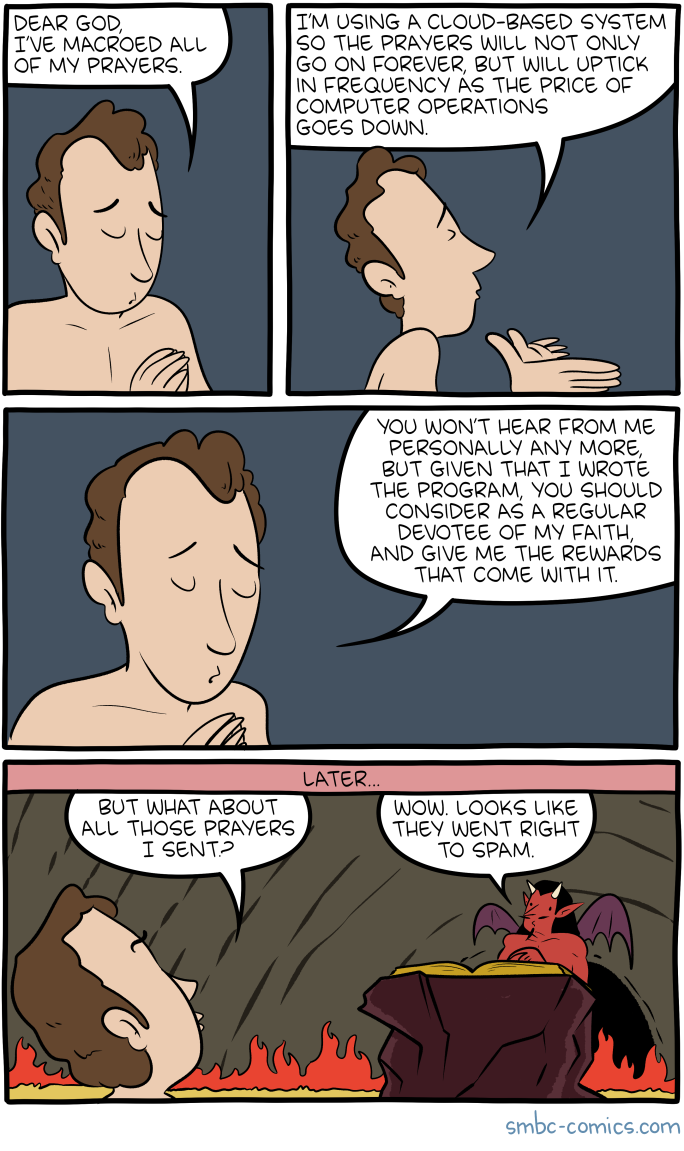
A man is praying to God, confessing that he has encoded all of his private information -- presumably embarrassing secrets, personal data, and sensitive material -- in a cloud-based system. He explains that the encryption is so sophisticated that no one can access the data unless they can factor large prime numbers, control the price of lithium, or survive a situation where the entire internet goes down. In other words, he has made his secrets virtually impossible to uncover through any normal means.
However, in the next panel we learn that God is not reassured: the man admits that "given that I wrote the program, you should worry less about the security of my data and more about the quality of my data." He is acknowledging that, despite the fortress-like encryption, the actual content is probably embarrassingly bad code or worthless information. In the final scene set "later," the man is shown in Hell, where the Devil remarks that it looks like his code went "right to GOTO." The implication is that his programming was so terrible (using GOTO statements, widely considered bad practice) that it was essentially sinful.
The Humor
The comedy works on multiple levels. First, there is the absurdity of confessing one's programming sins to God as though they were moral failings. Second, the elaborate security setup is undercut by the admission that the thing being protected is garbage anyway -- a classic anticlimax joke. The final punchline in Hell plays on the double meaning: the man's soul went "right to GOTO," punning on the infamous GOTO statement in programming (considered harmful since Edsger Dijkstra's famous 1968 letter) and the idea of going directly to Hell. The joke satirizes programmers who over-engineer security for systems built on fundamentally bad code.
References
The comic references several computing concepts: cloud-based encryption, prime factorization (the basis of RSA cryptography), and the GOTO statement, famously criticized in Dijkstra's 1968 paper "Go To Statement Considered Harmful." The mention of lithium prices alludes to the dependency of modern tech infrastructure on lithium-ion batteries.