magnitude
Explanation
The Joke
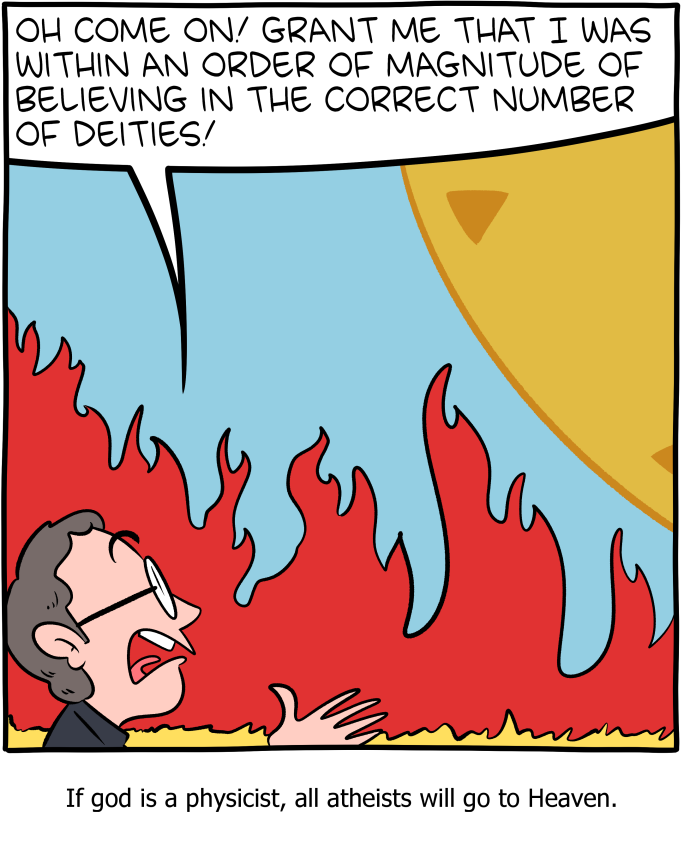
The comic shows a man standing at the gates of Hell, engulfed in flames, pleading his case to (presumably) God or a divine judge. He cries: "Oh come on! Grant me that I was within an order of magnitude of believing in the correct number of deities!" The caption below reads: "If god is a physicist, all atheists will go to Heaven."
The joke hinges on the mathematical concept of "order of magnitude." An atheist believes in zero gods. Most monotheistic religions believe in one god. In strict mathematical terms, zero and one are not within an order of magnitude of each other (since zero times ten is still zero). However, the comic plays on the physicist's tendency to round liberally and treat quantities that are "close enough" as equivalent. From a physicist's loose perspective, believing in zero gods versus one god is a much smaller error than, say, believing in thousands of gods.
The Humor
The humor works because it applies the famously loose standards of physicist approximation ("assume a spherical cow") to theology. Physicists are known for caring about orders of magnitude rather than exact values -- if you're off by a factor of two, that's often considered close enough. The man's argument is that being off by exactly one god (from zero to one) should be well within the margin of error. The caption's punchline -- that a physicist-God would let atheists into Heaven -- is funny because it suggests atheists are actually closer to the right answer than polytheists, since believing in zero gods is numerically closer to one than believing in hundreds or thousands. It also satirizes the theological concept that belief in the wrong number or type of gods is grounds for damnation, reframing it as an absurdly precise measurement problem.
References
"Order of magnitude" is a mathematical term referring to a factor-of-ten difference. The joke touches on Pascal's Wager and the broader theological problem of religious pluralism -- the question of which religion's god(s) to believe in when making your cosmic bet. The Fermi estimation tradition in physics, where rough approximations are valued over precision, is central to the joke's premise.