malthus

Explanation
This comic is a clever, self-referential joke about Thomas Malthus and Malthusian thinking.
Thomas Malthus (1766-1834) was an English economist who famously argued that human population grows geometrically (exponentially), while food production grows only arithmetically (linearly). He concluded that population would inevitably outstrip resources, leading to famine, disease, and societal collapse. This prediction has been repeatedly debunked by technological progress -- the Green Revolution, modern agriculture, and other innovations have allowed food production to keep pace with (and exceed) population growth.
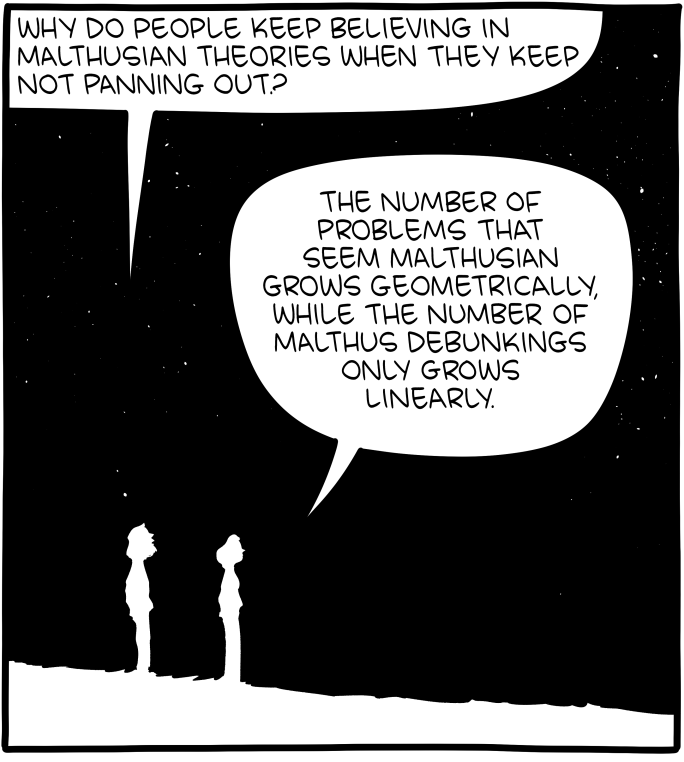
In the comic, one person asks: "Why do people keep believing in Malthusian theories when they keep not panning out?" The response is brilliantly self-referential: "The number of problems that seem Malthusian grows geometrically, while the number of Malthus debunkings only grows linearly."
The joke works on multiple levels. First, it uses Malthus's own framework (geometric vs. linear growth) to explain why Malthusian thinking persists -- a delicious irony. Second, it contains a genuine insight: new technologies and social changes constantly create new categories of problems that look like they might follow a Malthusian pattern (resource depletion, climate change, AI risks, etc.), so even though each individual Malthusian prediction gets debunked, new ones arise faster than the old ones are refuted. Third, there is a meta-joke in the structure: if the explanation is itself correct, then Malthusian thinking is in some sense vindicated after all -- Malthusianism about Malthusianism is true, even if individual Malthusian predictions are false.
The dark nighttime setting with two silhouetted figures gives the exchange a contemplative, almost existential tone appropriate for the philosophical nature of the observation.