mandelbrot

Explanation
The Joke
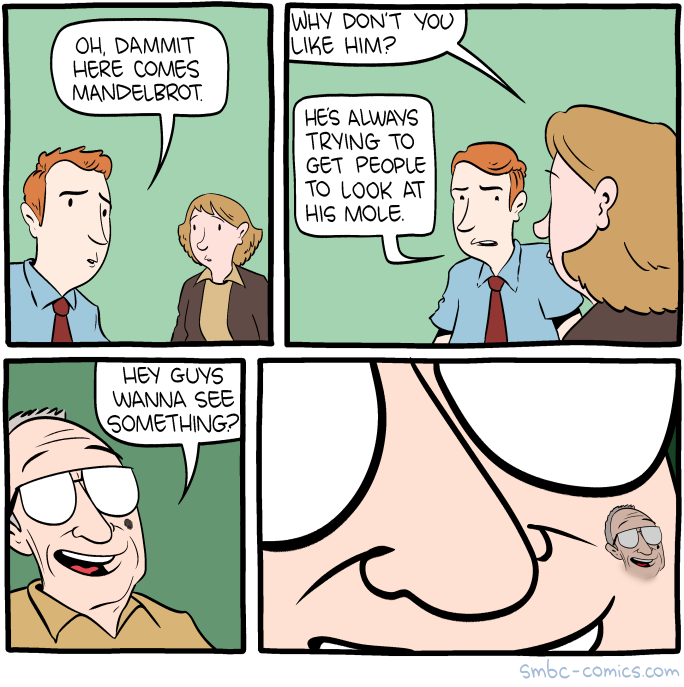
Two people are standing together when one says "Oh, dammit, here comes Mandelbrot." The other asks why they don't like him, and the first person explains: "He's always trying to get people to look at his mole." In the lower panels, Mandelbrot approaches with an eager "Hey guys, wanna see something?" and the comic zooms in on his face to reveal a mole on his nose -- but the mole itself contains a tiny, detailed replica of his face, which presumably also has a mole containing an even tinier face, and so on to infinity.
The punchline is entirely visual: Mandelbrot's mole is a fractal -- it's self-similar at every scale, containing an infinitely recursive copy of the whole.
The Humor
The joke is a pun on the mathematical concept of the Mandelbrot set, one of the most famous fractals in mathematics, named after mathematician Benoit Mandelbrot. The Mandelbrot set is known for its property of self-similarity -- when you zoom into its boundary, you find smaller copies of the overall shape repeated at every level of magnification. The comic literalizes this by giving the man named Mandelbrot a facial mole that is itself a tiny Mandelbrot (with his own mole, ad infinitum). The social awkwardness of someone always wanting to show off their weird mole adds a layer of everyday comedy to the mathematical concept.
References
Benoit Mandelbrot (1924-2010) was a Polish-born French-American mathematician who coined the term "fractal" and is best known for the Mandelbrot set, a set of complex numbers whose boundary forms an infinitely detailed fractal shape. The set is generated by iterating the function z(n+1) = z(n)^2 + c and checking whether the result remains bounded. The Mandelbrot set's most visually striking property is the appearance of miniature copies of the overall shape at increasingly fine scales along its boundary.