marshmallow-test

Explanation
The Joke
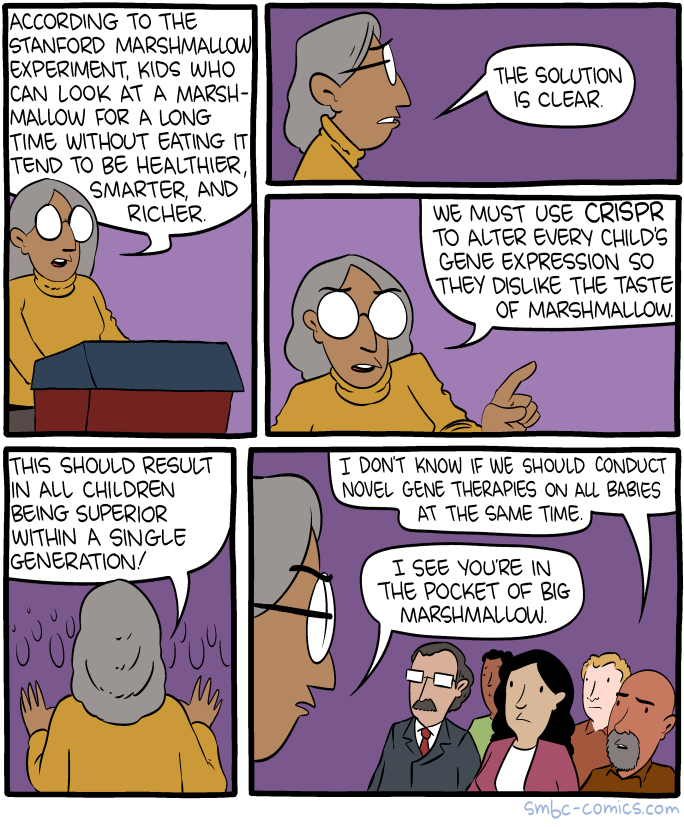
The comic references the famous Stanford marshmallow experiment, in which children were offered a choice between one marshmallow immediately or two marshmallows if they could wait for a period. The study found that children who could delay gratification tended to have better life outcomes. The comic's characters, upon learning this, propose an absurd technological solution: using CRISPR gene editing to alter every child's taste buds so they dislike the taste of marshmallows, thereby making every child "pass" the test.
A skeptic in the group points out that this would not actually make children better -- they would all simply refuse the marshmallow because they find it disgusting, not because they have developed self-control. The proponents dismiss this objection, arguing the children would still be "superior" because they would possess "the pocket of no marshmallow," completely missing the point that the marshmallow test measures an underlying trait, not marshmallow-specific behavior.
The Humor
The comic satirizes a common error in reasoning: confusing a metric with the thing it measures, often called Goodhart's Law ("When a measure becomes a target, it ceases to be a good measure"). The characters want to hack the test rather than develop the actual quality being tested. This is a pointed commentary on how institutions and policymakers often optimize for measurable outcomes -- test scores, KPIs, rankings -- while ignoring the underlying capabilities those metrics are supposed to reflect. The absurdity of genetically engineering children's taste preferences to game a psychology experiment makes the satire especially vivid.
References
The Stanford marshmallow experiment was conducted by psychologist Walter Mischel in the late 1960s and early 1970s. CRISPR (Clustered Regularly Interspaced Short Palindromic Repeats) is a real gene-editing technology that has been the subject of significant ethical debate regarding its potential use in human modification.