matching
Explanation
The Joke
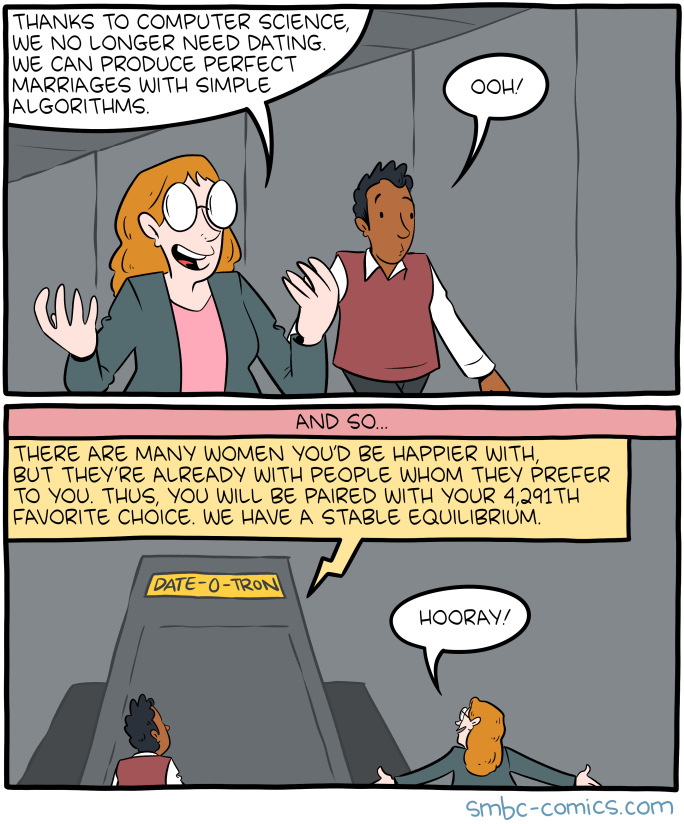
A scientist excitedly announces that thanks to computer science, dating is no longer necessary -- perfect marriages can be produced with simple algorithms. The scene then cuts to the result: a machine called "Date-O-Tron" informs a man that while there are many women he would be happier with, they are all already with people whom they prefer over him. Therefore, he will be paired with his 4,291st favorite choice. The machine declares this a "stable equilibrium," and the man sarcastically cheers, "Hooray!"
The Humor
The comic takes the real mathematical concept of stable matching (specifically the Gale-Shapley algorithm) and shows what it would actually feel like from the perspective of someone on the losing end. In stable matching theory, a "stable" outcome means no two people would both prefer to be with each other over their current partners -- but that does not mean anyone is happy. The algorithm guarantees stability, not satisfaction. The joke is that the mathematically optimal solution is emotionally devastating: being told you are getting your 4,291st choice is technically a success by the algorithm's standards, but it is a crushing outcome for the human involved. The cheerful scientific framing ("We have a stable equilibrium!") contrasted with the bleak personal reality is the core of the humor.
References
The comic references the Gale-Shapley stable matching algorithm (1962), which won Lloyd Shapley and Alvin Roth the 2012 Nobel Prize in Economics. The algorithm is used in real-world matching markets, including the National Resident Matching Program for medical residencies. A well-known property of the algorithm is that it produces outcomes that are optimal for the proposing side but can be pessimal for the receiving side.