math
Explanation
The Joke
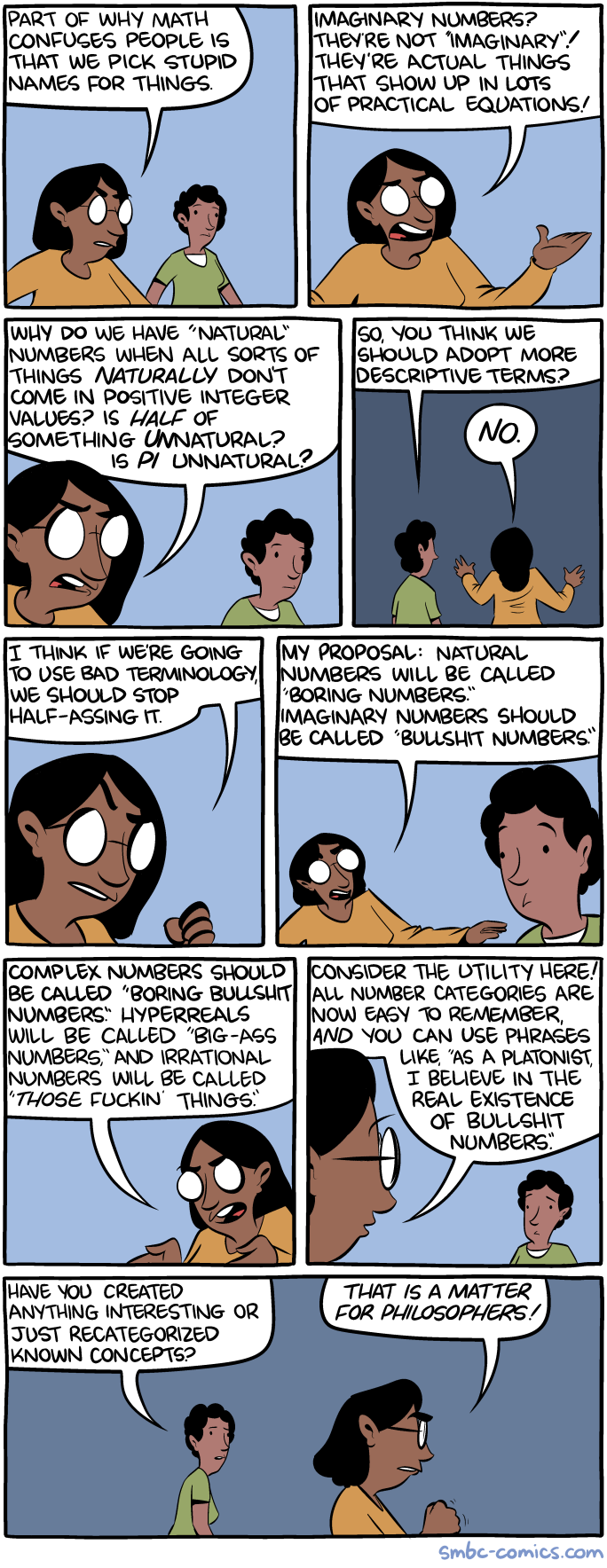
Two mathematicians discuss the confusing naming conventions in mathematics. One points out that "imaginary numbers" are not actually imaginary -- they are real mathematical objects that appear in many practical equations. Similarly, "natural numbers" are called "natural" even though plenty of things in nature don't come in positive integer values (is half of something "unnatural"? is pi "unnatural"?). When asked if mathematics should adopt more descriptive terms, the other mathematician emphatically says "No" -- and instead proposes making the names even worse.
The proposed renaming scheme escalates hilariously: natural numbers become "boring numbers," imaginary numbers become "bullshit numbers," complex numbers become "boring bullshit numbers," hyperreals become "big-ass numbers," and irrational numbers become "those fuckin' things." When challenged about whether this has created anything interesting or just recategorized known concepts, the mathematician deflects: "That is a matter for philosophers."
The Humor
The comic satirizes a real and well-known complaint about mathematical terminology -- that many terms are historical accidents that confuse students and laypeople. Names like "imaginary," "irrational," and "complex" carry misleading connotations that have nothing to do with the actual mathematical objects. But rather than fixing this problem, the comic's mathematician doubles down on the absurdity by proposing names that are even more informal and unhelpful, revealing that mathematicians perhaps enjoy their esoteric jargon. The escalating vulgarity of the proposed names (from "boring" to "bullshit" to "those fuckin' things") is the comedic engine, and the final dodge to philosophy is a classic academic deflection -- "that's not my department."
References
- Imaginary numbers (involving the square root of -1) were historically named "imaginary" by Rene Descartes as a dismissive term, yet they are fundamental to electrical engineering, quantum mechanics, and signal processing.
- The "natural" vs. "unnatural" distinction for numbers is a genuine pedagogical complaint, as is the misleading nature of the term "irrational" (which simply means a number cannot be expressed as a ratio, not that it is unreasonable).
- The comic reflects a broader SMBC theme of poking fun at academic conventions and the gap between technical language and common understanding.